
Monogamy, Polyamory, or Something Else? Dr. Eli Sheff on Relationships, CNM, and Polyamorous Families
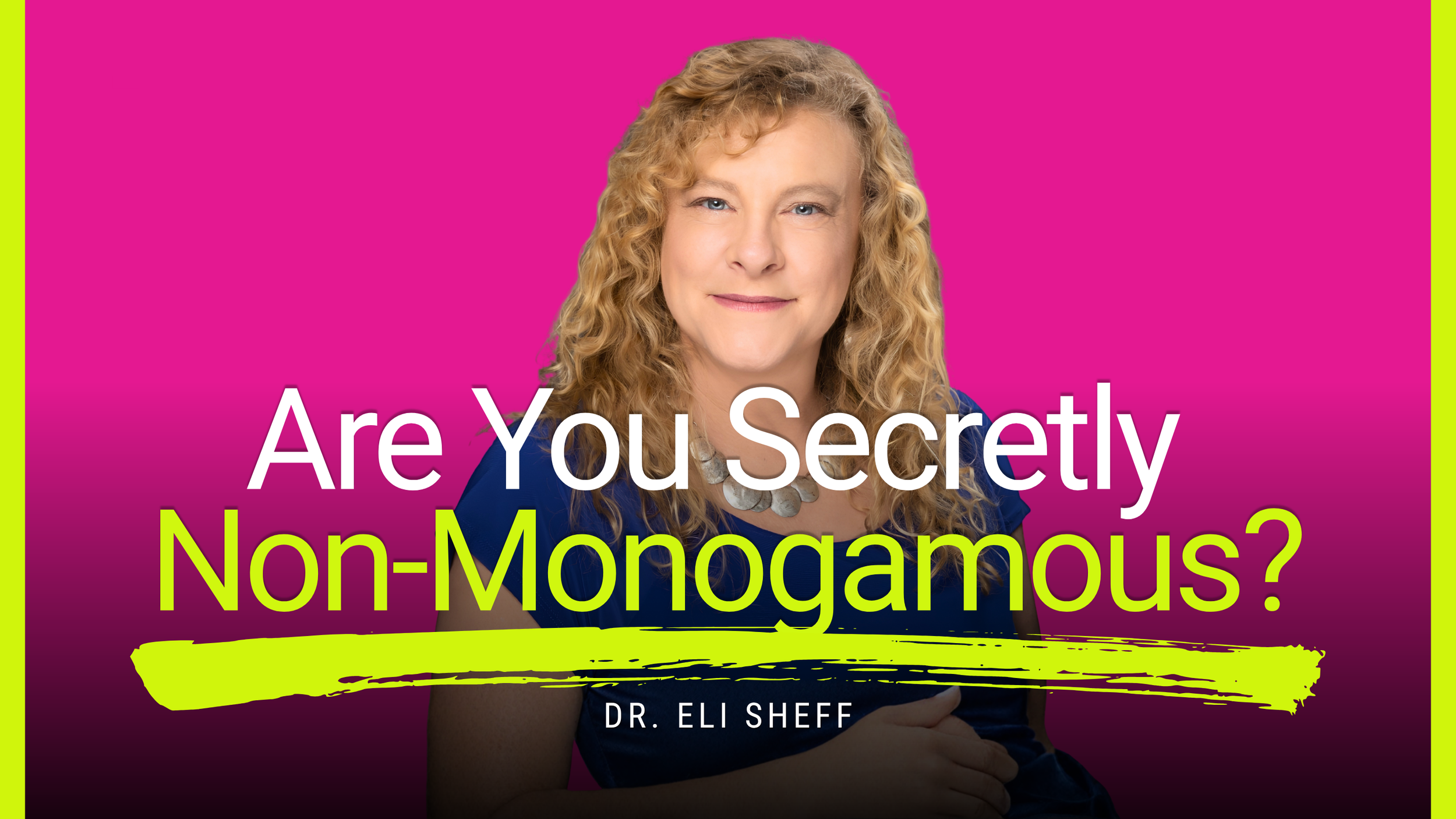
What if the question isn't whether monogamy or polyamory is better?
What if the better question is: What kind of relationship actually works for you?
For more than 25 years, sociologist Dr. Eli Sheff has studied people whose relationships don't always fit conventional expectations. Her research offers a window into consensual non-monogamy, polyamorous relationships, and families raising children outside the traditional two-parent monogamous model.
Across this two-part conversation on The Sexology Lab, we move from one deeply personal question—How do I want to love?—to a much bigger cultural one: What actually makes a family work?
What These Episodes Explore
"How do you know if anything is right for you?" — Dr. Eli Sheff
In Part 1, "Monogamy, Polyamory, or Something Else? Finding Your Relationship Style with Dr. Eli Sheff," we explore the diversity of modern relationships.
Dr. Sheff explains the differences between consensual non-monogamy, open relationships, polyamory, swinging, and polygamy. She also introduces the Bonding Project, a free relationship assessment designed to help people consider how they prefer to connect with others.
We also get into the messier questions: How do you know if polyamory is right for you? What happens when partners want different things? What is unicorn hunting? And what are the biggest mistakes couples make when opening their relationships?
Then, in Part 2, "The Kids Are Alright: Dr. Eli Sheff on 25+ Years of Polyamorous Family Research," we turn to Dr. Sheff's longitudinal research on polyamorous families with children.
Her findings challenge assumptions about what family stability has to look like—and raise a fascinating possibility: maybe the number of adults in a family matters less than the quality of the relationships between them.
Guest Introduction
"You can be however and whoever you want." — Dr. Eli Sheff
Dr. Eli Sheff is a sociologist, certified sexuality educator, researcher, author, and one of the foremost academic experts on polyamorous families and consensual non-monogamy.
She began studying polyamorous families in 1996, when research on contemporary polyamory was extremely limited. More than 25 years later, her work has followed families across decades and contributed to a growing academic understanding of consensual non-monogamy, relationships, parenting, and family diversity.
Dr. Sheff is also the Director of Sexual Health Alliance's Advanced Certification in Consensual Non-Monogamy.
3 Key Takeaways
There isn't one "correct" relationship style. People differ in how much exclusivity, independence, emotional intimacy, sexual openness, and commitment they want—and those needs can change throughout life.
Wanting multiple partners yourself is only half the question. If you're considering consensual non-monogamy, Dr. Sheff suggests asking how you would feel about your partner having other relationships too.
Family structure alone doesn't determine family health. In Dr. Sheff's research sample, children in polyamorous families demonstrated resilience and benefited from communication skills and networks of supportive adults. Her findings challenge assumptions that polyamorous family structures inherently create instability for children.
Who These Episodes Are For
Anyone curious about polyamory or consensual non-monogamy
People questioning whether traditional monogamy fits them
Couples considering opening their relationship
Parents interested in alternative family structures
Professionals working with CNM or polyamorous clients
Anyone curious about what decades of polyamory research actually reveals
In These Episodes, We Cover:
What is consensual non-monogamy?
What is the difference between polyamory and an open relationship?
How do you know if polyamory is right for you?
What is the Bonding Project?
Can partners have different relationship orientations?
What is couples privilege?
What does "unicorn hunting" mean?
Why is polyamory different from polygamy?
What mistakes do couples make when opening a relationship?
What does research say about children raised in polyamorous families?
What are polyaffective relationships?
Are polyamorous families less stable?
How can having multiple caring adults affect children?
What does pop culture get wrong about consensual non-monogamy?
Consensual Non-monogamy Quick Answer
What's the difference between polyamory and consensual non-monogamy?
Consensual non-monogamy (CNM) is a broad umbrella term for relationships in which people mutually agree that partners can have sexual and/or romantic connections with others.
Polyamory falls underneath that umbrella but generally includes openness to emotional intimacy and potentially long-term relationships with multiple people.
Dr. Sheff explains that other forms of CNM can operate differently. Swinging, for example, often places much greater emphasis on the established couple, while polyamorous communities may be more likely to question "couples privilege" and the assumption that an original couple should always take precedence over other relationships.
What does research say about children in polyamorous families?
Dr. Sheff says her longitudinal research challenges the assumption that children in polyamorous families are inherently confused or destabilized by their family structure.
Within her research sample, she has observed stability, supportive relationships with multiple adults, strong communication skills, and resilience.
She also emphasizes the limits of those findings. Her sample is approximately 200 people and includes long-term participants who were relatively early adopters of polyamory. Her research should not be interpreted to mean every polyamorous family is healthy or functional.
Rather, her findings suggest that polyamory itself does not automatically create the problems critics often assume it does.
Expanded Insight
Maybe You Don't Hate Relationships. Maybe You Hate the Relationship Script.
One of the most interesting ideas in Part 1 comes from the Bonding Project, which Dr. Sheff developed with her colleague Jess Wise.
The project grew partly out of something Wise repeatedly encountered while dating:
People would say they wanted companionship—but didn't want a "relationship."
When she dug deeper, the problem often wasn't connection.
It was everything people assumed came with the word relationship.
Move in together.
Get married.
Combine finances.
Have children.
Build your lives around each other.
In relationship research and CNM communities, this progression is often described as the relationship escalator.
But what if you want intimacy without climbing every step?
What if your career is central to your life?
What if friendships fulfill many of your emotional needs?
What if you want a committed partner but don't want to live together?
What if you want multiple partners?
Or what if you genuinely want monogamy and deep exclusivity?
The Bonding Project starts from a deceptively simple premise:
All of those possibilities can be valid.
The more useful question is whether the people involved understand what they want—and whether their needs are compatible.
Is Polyamory Right for You?
Dr. Sheff offers a particularly useful thought experiment for people who are curious about polyamory.
Don't just imagine yourself dating multiple people.
Imagine your partner doing it.
That's where the question often becomes much more revealing.
It's easy to imagine the upside of consensual non-monogamy when you're picturing yourself receiving more sex, attention, affection, novelty, or romantic connection.
It's another thing to imagine your partner getting dressed for a date while you're staying home.
For some people, that idea feels freeing.
For others, it creates immediate distress.
Neither reaction automatically makes someone more evolved, secure, enlightened, or sexually sophisticated.
It may simply tell you something important about what kind of relationship feels right for you.
One of the Biggest Mistakes: The Unicorn Fantasy
Part 1 also tackles one of the most persistent patterns in consensual non-monogamy: unicorn hunting.
Dr. Sheff describes the familiar scenario of an established male-female couple looking for a bisexual woman to join their relationship.
The problem isn't that three people can't build a meaningful relationship.
It's the expectations that can come with the search.
The new partner may be expected to fit neatly into the existing couple's life, be attracted to both partners, remain exclusive to them, avoid threatening the original relationship, and accept that the established couple's needs come first.
That's a lot to ask of a human being.
It's also why the hypothetical bisexual woman who effortlessly meets every one of these expectations has earned the nickname "unicorn."
The conversation expands from there into gender, homophobia, pornography, and the cultural double standard that can celebrate sexual contact between women while treating sexual contact between men very differently.
And Dr. Sheff offers an important reality check for people whose expectations of group sex come from pornography:
Porn is a performance.
It isn't a blueprint for how real people will behave together.
Part 2: What Happens When Polyamorous People Have Kids?
"The kids in my study talk about being able to go to college and... reestablish a network of caring individuals, like a safety net of social support." — Dr. Eli Sheff
This is where the conversation takes an especially fascinating turn.
Dr. Eli Sheff has been studying polyamorous families since the 1990s.
And one of the assumptions she repeatedly encountered was that the children must be struggling.
Are they confused?
Do parental figures constantly disappear?
Is the home unstable?
Are children being exposed to inappropriate sexuality?
Dr. Sheff says those assumptions don't reflect what she has observed in her research sample.
Some of the relationships she has studied have lasted for decades.
More importantly, she found that the relationships holding these families together weren't always sexual.
That observation became important enough that she created a word for it:
Polyaffective.
What Is a Polyaffective Relationship?
A polyaffective relationship is an emotionally significant, nonsexual relationship between people connected through a polyamorous relationship or family network.
Why does that matter?
Because sexual and romantic relationships can change.
People stop having sex.
Romantic feelings evolve.
Relationships get redefined.
But that doesn't necessarily mean every meaningful bond surrounding that relationship has to disappear.
Dr. Sheff describes these emotional connections as part of the "glue" that can hold some polyamorous families together over time.
Instead of family stability depending entirely on whether two adults remain sexually or romantically connected, people can maintain commitments to children and to one another even as the form of their relationship changes.
What About the Kids?
Perhaps one of the most revealing moments from Dr. Sheff's research came when a child challenged her assumptions.
Dr. Sheff had repeatedly asked young people about losing their parents' former partners.
Eventually, one essentially pointed out:
Why do you keep asking about this?
The losses that had mattered more included experiences familiar to children from countless family structures—a best friend moving away and the death of a beloved grandparent.
That challenged the assumption that a parent's dating partner automatically becomes a parental figure whose departure is uniquely destabilizing.
According to Dr. Sheff, children in these families often understand the distinction.
A parent's partner might simply be Mom's or Dad's partner.
Over time, someone who lives with the family, provides care, and remains involved for years may become a parental figure.
Others may function more like an aunt, uncle, or trusted family friend.
And that can provide something valuable:
More trusted adults.
The Kids Are Learning Relationship Skills, Too
Another pattern Dr. Sheff highlights is the amount of communication happening inside many of the families she has studied.
Polyamorous adults often have to talk explicitly about things monogamous couples may be able to leave unspoken:
Boundaries.
Jealousy.
Time.
Needs.
Conflict.
Expectations.
Changes in relationships.
Those conversations can become part of the environment children grow up observing.
Dr. Sheff says some of the young adults in her research demonstrated a particularly valuable ability when they left home:
They knew how to build community.
When they went away to college or moved somewhere unfamiliar, they were able to create networks of trusted people around themselves.
In her view, that ability to establish a "safety net of social support" may be one of the most valuable skills children can learn from these family environments.
Does That Mean Polyamorous Families Are Better?
No.
And this distinction matters.
Dr. Sheff is careful not to claim that every polyamorous family is healthy or that CNM automatically produces better outcomes for children.
Her sample is relatively small—approximately 200 people—and includes long-term participants who were early adopters of polyamory.
What her findings challenge is a different claim:
That polyamory itself inherently makes a family dysfunctional.
The disadvantages she has observed—relationship transitions, stigma, loss, conflict, changing household arrangements—are not unique to polyamorous families.
Monogamous families experience divorce.
People die.
Families relocate.
Relationships change.
Children experience stigma because of divorce, interracial families, LGBTQ+ parents, religion, class, and countless other aspects of family life.
The more interesting question may not be whether a family looks conventional.
It may be whether the people inside it are safe, supported, respected, and able to rely on each other.
Maybe We're Asking the Wrong Relationship Question
Both parts of this conversation ultimately lead back to the same idea.
We're accustomed to asking:
What's the right way to have a relationship?
Monogamy?
Polyamory?
Marriage?
Living together?
Separate bedrooms?
Multiple partners?
One lifelong partner?
Dr. Sheff's work invites a different set of questions.
What actually works for the people involved?
Is everyone consenting?
Can they communicate?
Can they negotiate differences?
Do they feel supported?
Are children receiving stability and appropriate care?
Can relationships change without automatically becoming failures?
The answers won't lead everyone to polyamory.
They shouldn't.
For some people, monogamy provides exactly the exclusivity, stability, and connection they want.
For others, a different structure may fit better.
Perhaps the goal isn't finding the relationship structure everyone should follow.
It's understanding yourself well enough to build the one that actually works for you.
Listen to Both Episodes
Start with Part 1: Monogamy, Polyamory, or Something Else? Finding Your Relationship Style with Dr. Eli Sheff for a deep dive into consensual non-monogamy, polyamory, relationship compatibility, unicorn hunting, and finding a relationship structure that fits.
Then continue with Part 2: The Kids Are Alright: Dr. Eli Sheff on 25+ Years of Polyamorous Family Research for a closer look at parenting, polyaffective relationships, family stability, and what Dr. Sheff has learned from decades of studying polyamorous families.
Listen to The Sexology Lab on Apple Podcasts, Spotify, and YouTube.
Related Topics
Why We Get Jealous: Dr. Justin Mogilski on Pair Bonding, Competition, and Communication | Episode 13
Want More Conversations Like This?
If you want deeper, research driven conversations about sex, relationships, and culture, join the Sexology Lab newsletter. Get expert insights, real world perspectives, and conversations that challenge outdated thinking and replace it with something more useful.
About The Sexology Lab
The Sexology Lab explores the intersection of sexual health, psychology, and culture. Through expert conversations, we challenge outdated narratives and provide research driven insights into relationships, desire, and human behavior.
