
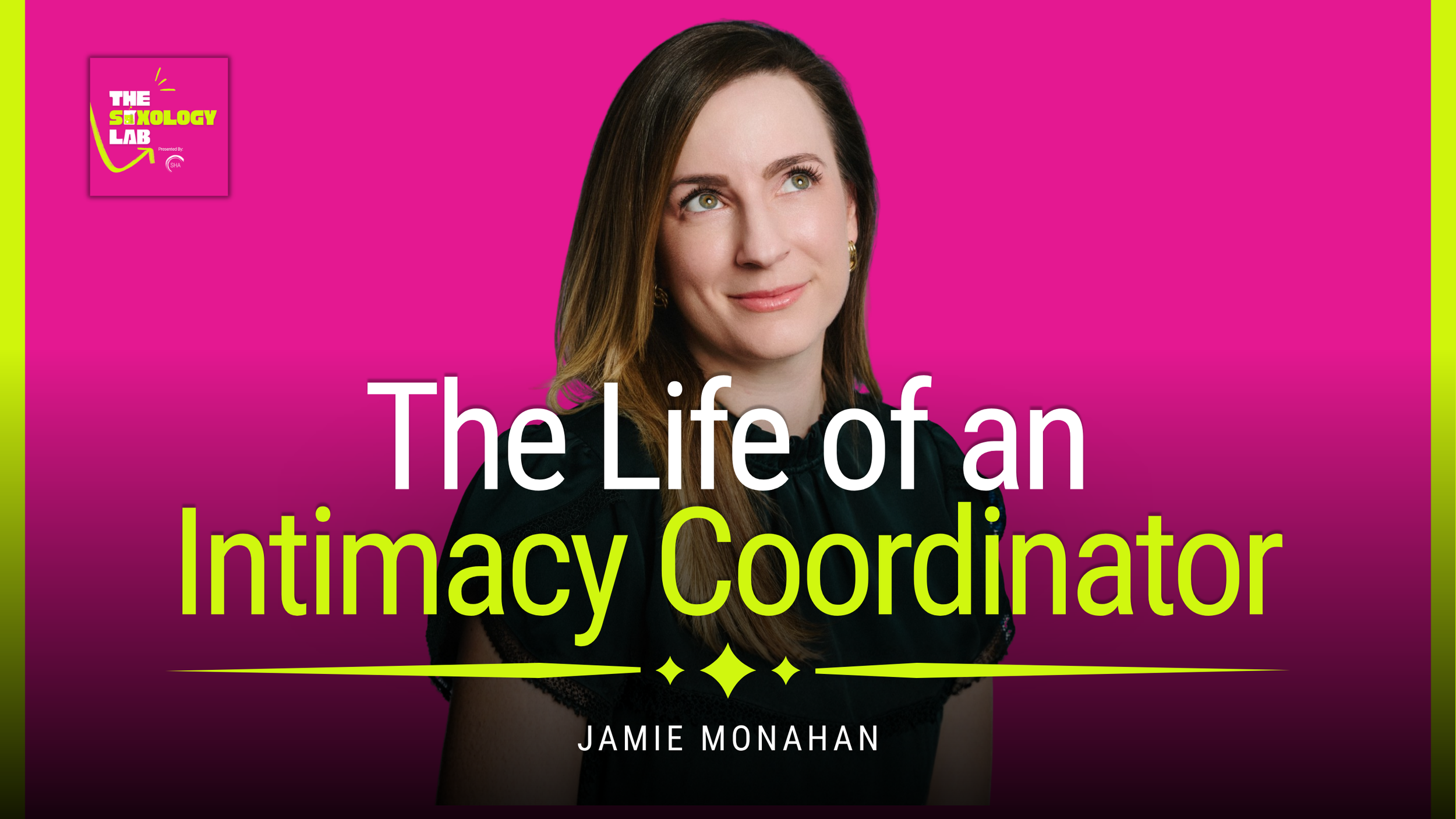
What Really Happens When Actors Film Intimate Scenes? | Jamie Monahan | Episode 28
Two actors. A closed set. An intimate scene that looks completely spontaneous.
What viewers don't see?
The choreography. The camera crew. The boom operator. The boundaries. The consent conversations. The power dynamics. And, increasingly, the intimacy coordinator helping bring all of those pieces together.
In this episode of The Sexology Lab, intimacy coordinator and intimacy director Jamie Monahan takes us behind the camera to explain what really happens when actors film intimate scenes—and why the job of an intimacy coordinator is about much more than making sure nobody crosses a line.
It's also about storytelling.
What This Episode Explores
"It's a lot less sexy in terms of shooting than people realize.” — Jamie Monahan
Intimacy coordination is still a relatively new profession, and Jamie says misconceptions about the role are common.
An intimacy coordinator isn't simply standing on set policing actors.
Jamie describes the role as part choreographer, part advocate, part creative collaborator, and part resource for performers navigating an industry where significant power imbalances can exist.
We explore how intimate scenes are planned and performed, what happens when one actor wants an intimacy coordinator and another doesn't, how consent can become part of storytelling, and why the best intimate scenes reveal something about the characters rather than existing simply for spectacle.
We also step into the growing world of audio erotica through Jamie's work with Quinn Audio and Ember and Ice, exploring how intimacy changes when audiences aren't watching the story at all—they're listening to it and becoming part of it.
Guest Introduction
"I am part choreographer, part someone who is a resource for actors that is outside of the power dynamics and structure of the entertainment industry." — Jamie Monahan
Jamie Monahan is an intimacy coordinator and intimacy director whose background includes acting, dance, directing, and movement.
Jamie knew she wanted to be an actor from childhood and eventually studied acting while minoring in dance before moving to New York and beginning her professional career.
Her path toward intimacy coordination began while directing a scene depicting sexual assault. The scene went well and the performers felt supported, but Jamie sensed that something was missing.
Later, intimacy training gave her language for what she had noticed: actors may understand intellectually that they are performing, while their bodies are still moving through the physical and emotional experience of intense material.
That discovery led Jamie into workshops, further training, and eventually certification as an intimacy professional. At the time of this conversation, she says she has worked on more than 50 productions.
3 Key Takeaways
Intimate scenes are far more technical than they appear. Choreography, camera positions, crew members, boundaries, story, and performance all have to come together to create something that ultimately feels spontaneous to the viewer.
Intimacy coordinators do more than prevent harm. They can advocate for performers while also helping directors and actors create intimacy that adds nuance, character development, and meaning to a story.
Power matters when we're talking about consent. An established star and an emerging actor may technically have the same ability to voice a boundary, but that doesn't mean saying "no" feels equally possible for both.
Who This Episode Is For
Anyone curious about what happens behind the scenes of film and television
Actors and performers
Directors and filmmakers
Intimacy coordinators and people interested in the profession
Romance and audio-erotica fans
People interested in consent and power dynamics
Anyone interested in how media shapes our understanding of intimacy
In This Episode, We Cover
What an intimacy coordinator actually does
What filming an intimate scene really looks like
Why intimate scenes are choreographed
Closed sets and who is actually in the room
Consent and boundaries between performers
Power dynamics between established and emerging actors
Why an actor may still benefit from an intimacy coordinator when they trust their scene partner
How Jamie became an intimacy coordinator
Trauma-informed practices for performers
Intimacy coordination vs. intimacy direction
The rise of intimacy coordination after #MeToo
How intimate scenes can develop characters
Consent and aftercare in storytelling
Media's influence on sexual knowledge
The male gaze and representations of pleasure
Audio erotica and immersive storytelling
Jamie's work with Quinn Audio
Tracking a character's intimacy arc
Intimacy Coordinator Quick Answer
What does an intimacy coordinator do?
An intimacy coordinator works with actors, directors, and production teams on intimate content in film and television.
Jamie describes the role as part choreographer and part advocate.
An intimacy coordinator can help performers establish and communicate boundaries, choreograph physical interactions, navigate power differences, and discuss concerns about intimate material. They can also collaborate creatively with directors and actors so that intimacy serves the characters and story.
Jamie distinguishes this from an intimacy director, who performs a similar role in theater and live performance.
Why do actors need intimacy coordinators?
Actors work within a professional hierarchy where saying "no" can feel complicated.
A performer may worry that voicing discomfort will make them appear difficult, cost them the current job, or affect future opportunities.
Those pressures can become especially significant when a lesser-known performer is working opposite a major star.
Jamie explains that an intimacy coordinator can't eliminate those power dynamics. Instead, they can acknowledge them and provide performers with someone who can help communicate and advocate around boundaries.
And their role isn't limited to preventing misconduct.
Intimacy coordinators can also help choreograph scenes and make intimate storytelling more specific, intentional, and believable.
Expanded Insight
Intimate Scenes Aren't As Spontaneous As They Look
"The power dynamics, I can't eliminate them. No one can. Power exists." — Jamie Monahan
When an intimate scene works, viewers shouldn't be thinking about the mechanics behind it.
They're watching two characters.
They're invested in the relationship.
The moment feels private.
But Jamie points out that creating that illusion can involve a surprising number of people.
Even on a closed set, actors may be surrounded by camera operators, a boom operator, essential crew members, and an intimacy coordinator.
Then there is the choreography itself.
Movements have to work for the performers.
They have to remain within established boundaries.
They have to communicate the director's vision.
And they have to work for the camera.
The result might look effortless.
The process is anything but.
What Does an Intimacy Coordinator Actually Do?
"Your body doesn't know that you're not having this traumatic experience." — Jamie Monahan
Jamie describes herself as a resource who exists somewhat outside the traditional power structure actors are navigating.
That matters.
An actor might be perfectly comfortable talking to another performer but hesitant to tell a director that something doesn't feel right.
They may worry about being labeled difficult.
They may not want to hold up production.
They may be afraid that declining something could affect future opportunities.
An intimacy coordinator gives actors another person with whom they can discuss boundaries and concerns.
But advocacy is only part of the job.
There's choreography.
Story analysis.
Movement.
Communication.
Understanding power dynamics.
Bystander intervention.
Trauma-informed practice.
And collaboration with the creative team.
Jamie argues that reducing intimacy coordination to "making sure nobody is creepy" fundamentally misunderstands the profession.
"I Trust My Co-Star" Doesn't Eliminate the Power Dynamic
What if an actor says they don't need an intimacy coordinator because they trust the person they're working with?
Jamie sees a problem with the premise.
First, preventing misconduct isn't the only reason an intimacy coordinator is there.
But there's another issue:
There are two actors in the scene.
An established performer may feel completely comfortable.
Their emerging co-star might not.
Imagine you're relatively new to the industry and suddenly performing an intimate scene opposite someone with significantly more fame and professional influence.
You might become so concerned with respecting the star's boundaries and reputation that you stop advocating for your own.
Jamie explains that an intimacy coordinator can help remind that performer that they are an equal participant in the scene.
Their boundaries matter too.
Consent Gets Complicated When Your Job Is Involved
This is where intimacy coordination intersects with a much broader conversation about consent.
It's difficult to separate consent from power.
Jamie talks about older industry practices in which performers could arrive on set and encounter last-minute changes involving nudity or simulated intimacy.
Now, according to Jamie, performers must receive advance notice before those kinds of changes.
That time matters.
An immediate decision made on a working set, surrounded by colleagues, while production money is being spent is very different from a decision someone has time to consider.
Jamie doesn't suggest that an intimacy coordinator can erase the underlying hierarchy.
As she puts it, power exists.
The goal is to understand how that power can affect someone's ability to speak freely.
Intimacy Should Tell Us Something About the Characters
One of Jamie's most interesting points isn't about performer safety at all.
It's about storytelling.
Why do some intimate scenes feel meaningful while others feel gratuitous?
Jamie believes the difference often comes down to whether the scene tells us anything.
Intimacy can reveal parts of a character we don't see elsewhere.
Someone who appears emotionally distant may suddenly become attentive and vulnerable.
A character who communicates poorly in everyday life may communicate beautifully through touch.
Two people may say one thing to each other while their physical interactions reveal something entirely different.
Intimacy becomes another form of character development.
That's also why Jamie tracks what she calls the intimacy arc.
Where are these characters in their relationship?
Is this their first encounter?
Are they falling for each other?
Are they angry?
Have they betrayed each other?
Are they reconnecting?
Productions aren't necessarily filmed in chronological order, so an actor might perform a deeply connected scene one day and an early, tentative encounter the next.
The intimacy needs to reflect where those characters are emotionally at that particular point in the story.
Consent Can Be Part of the Story Too
For years, mainstream media frequently skipped over explicit communication around intimacy.
Characters simply seemed to know what the other person wanted.
Jamie is excited to see that changing.
She points to newer storytelling that incorporates consent check-ins and aftercare without making them feel like interruptions.
That's significant because entertainment doesn't only entertain us.
It also teaches us.
People learn about relationships and sexuality from television, movies, books, pornography, and now increasingly audio storytelling.
Jamie points out that much of the media previous generations consumed was shaped by a predominantly male lens and male gaze.
That influenced how audiences understood everything from female pleasure to how quickly someone "should" become aroused.
Showing more authentic intimacy can offer audiences a wider vocabulary for what connection, consent, pleasure, and communication can look like.
Enter Audio Erotica
Then there's an entirely different storytelling format:
Audio.
Jamie worked with Quinn Audio on Ember and Ice, an immersive fantasy-romance story.
Unlike watching two characters interact on screen, Quinn places the listener inside the experience.
You're not simply observing the scene.
The storytelling is constructed so that you become part of it.
That creates interesting possibilities for intimacy because there is no visual performance telling you exactly what everything looks like.
The listener's imagination completes the experience.
Jamie sees audio erotica as part of a much larger cultural interest in romance and intimate storytelling, alongside the rise of romance novels, romance-focused bookstores, and audiobooks.
Are We in a "Smut Renaissance"?
Maybe.
But Jamie has some reservations about the word.
She worries that calling the current explosion of intimate storytelling "smut" can unintentionally devalue what authors and creators are actually making.
These aren't necessarily stories where intimacy has simply been added for shock value.
They're stories about longing.
Romance.
Relationships.
Character.
Conflict.
And intimacy.
The intimate content can be one part of a much larger emotional arc.
That distinction mirrors Jamie's philosophy about intimate scenes on screen.
The question isn't simply whether intimacy is present.
It's whether it means something.
Your Body Doesn't Know You're "Just Acting"
Jamie's path into this profession started with a moment she couldn't quite explain.
While directing a scene depicting sexual assault, she felt that the actors had been supported and the scene itself worked.
But something was missing.
Later, intimacy training helped her identify it.
Performers need ways to separate themselves from the intense experiences their characters are moving through.
An actor can know intellectually:
This isn't real.
I'm performing.
This is choreography.
But their body is still participating in the experience.
Jamie became interested in creating space after particularly intense material for performers to reconnect with themselves and leave the character's experience behind.
That insight helped turn her curiosity about intimacy work into a career.
The Future of Intimate Storytelling
Intimacy coordination emerged because the entertainment industry needed better systems around vulnerable performances.
But Jamie's work demonstrates why its future could be about much more than risk prevention.
It's about creating better scenes.
Giving performers more tools.
Understanding power.
Building consent into production.
Thinking critically about what audiences learn from media.
And treating intimacy as an important part of storytelling rather than something actors should simply figure out once the cameras start rolling.
When it's done well, viewers may never notice the intimacy coordinator's work.
They'll simply believe the moment.
And perhaps that's the point.
Listen to the Episode
Listen to What Really Happens When Actors Film Intimate Scenes? on The Sexology Lab for the full conversation about intimacy coordination, consent, power dynamics, audio erotica, storytelling, performer advocacy, and what really happens behind the camera.
Listen on Apple Podcasts, Spotify, and YouTube.
Related Topics
The Camera Has a Point of View: Arthur Brun from Erika Lust on Indie Adult Cinema | Episode 22
Who Taught You About Pleasure? Laura Ramadei on Adult Media and Performance | Episode 18
Want More Conversations Like This?
If you want deeper, research driven conversations about sex, relationships, and culture, join the Sexology Lab newsletter. Get expert insights, real world perspectives, and conversations that challenge outdated thinking and replace it with something more useful.
About The Sexology Lab
The Sexology Lab explores the intersection of sexual health, psychology, and culture. Through expert conversations, we challenge outdated narratives and provide research driven insights into relationships, desire, and human behavior.
