
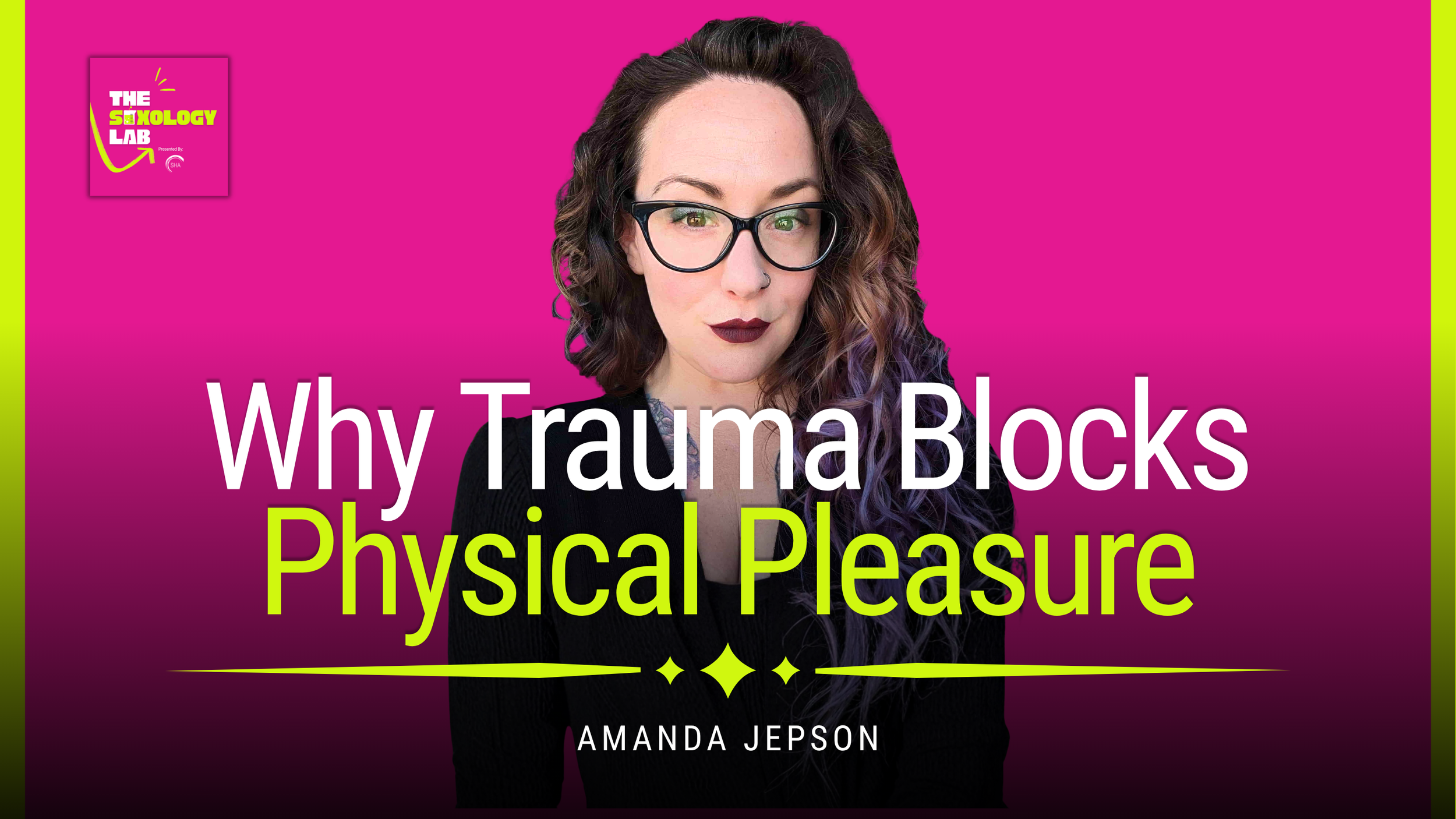
Trauma Doesn't Stay Outside the Bedroom | Amanda Jepson | Episode 27
Trauma doesn't only live in memories.
It can show up in the body.
In relationships.
In desire.
In touch.
In how safe it feels to be vulnerable with another person.
And, sometimes, in the bedroom.
In this episode of The Sexology Lab, sex therapist and trauma specialist Amanda Jepson explains why trauma of all kinds—not only sexual trauma—can affect sexuality, intimacy, pleasure, attachment, and the nervous system.
She also explains why trauma-informed sex therapy often means slowing down, building safety first, and helping people reconnect with pleasure on their own timeline.
What This Episode Explores
Amanda's work sits at the intersection of trauma therapy, sexuality, and affirming care for people whose identities or erotic lives are often left out of traditional clinical models.
She describes these clients as erotic minorities—people outside the identities most commonly centered when society talks about sexuality.
That can include queer and trans people, disabled people, people of color, larger-bodied people, kinky people, non-monogamous people, and others whose sexual experiences may not fit dominant cultural assumptions.
Throughout this conversation, Amanda explains why good sexual-health care requires more than learning a set of techniques.
It requires therapists to understand trauma, examine their own biases, listen closely to clients, and resist assuming that one sexual-health intervention will work for everyone.
Guest Introduction
Amanda Jepson is a SHA-certified and AASECT-certified sex therapist and trauma specialist who works with trauma survivors, military members, veterans, first responders, queer and trans clients, kinky people, non-monogamous people, and others seeking affirming sexual-health care.
Amanda began her career as a trauma therapist working in a rape and sexual abuse center.
As clients progressed through trauma treatment, she repeatedly noticed something missing.
Many were functioning better, but they were still struggling with pleasure, relationships, embodiment, and giving themselves permission to reconnect sexually.
That gap eventually led her to sex therapy.
Today, she integrates trauma-informed care with sexuality work while also training and supervising the next generation of clinicians.
3 Key Takeaways
Trauma does not have to be sexual to affect sexuality. Trauma can influence trust, desire, vulnerability, touch, attachment, nervous-system regulation, arousal, and orgasm.
Safety comes before deeper sexual reconnection. Trauma-informed care often begins with grounding, stabilization, coping skills, and helping clients understand their own activation before moving into more intensive sexual-health interventions.
Therapists must examine their own beliefs. Clients can be harmed when clinicians pathologize, judge, or over-romanticize kink, non-monogamy, pornography, sexuality, or other parts of a client's erotic life based on personal bias.
Who This Episode Is For
Trauma survivors trying to understand changes in desire or intimacy
Trauma therapists
Therapists working with queer, kinky, or non-monogamous clients
Military and veteran mental-health professionals
Anyone interested in how the nervous system affects sexuality
People rebuilding trust, pleasure, or connection after trauma
In This Episode, We Cover
What "erotic minority" means
How Amanda became a sex therapist
Why trauma-informed care benefits all sexual-health clients
Clinical bias around sexuality
Problematic and out-of-control sexual behavior
Shame around sexual fantasy and pornography
EMDR, CPT, CBT, DBT, and narrative therapy
Safety and stabilization
Trauma and the nervous system
Trauma's impact on desire
Why orgasm can feel threatening after trauma
Titration and pendulation
Knowing when someone is ready to reconnect sexually
Trauma and kink
Trauma and consensual non-monogamy
Attachment wounds
Affirming care for erotic minorities
Therapist bias and supervision
Sexual health in the current political climate
Ethics, documentation, and client safety
Trauma and Sex Quick Answer
Can trauma affect your sex life even if the trauma wasn't sexual?
Yes.
Amanda Jepson explains that trauma of many kinds can affect sexuality because trauma impacts the nervous system, trust, attachment, emotional safety, body awareness, and vulnerability.
Someone may become uncomfortable with touch, struggle to relax during intimacy, lose sexual desire, have difficulty communicating needs, or experience physical activation during sex that feels similar to danger.
This doesn't mean every sexual difficulty is caused by trauma.
It means trauma is one possible factor clinicians should understand and assess without automatically assuming it is the explanation.
Why can trauma make orgasm difficult?
Sexual arousal requires the body to move through changing levels of nervous-system activation.
Amanda explains that a person first needs enough relaxation and safety to become aroused.
But orgasm involves a significant increase in activation.
For some trauma survivors, that level of physiological activation can resemble the sensations their nervous system associates with threat or danger.
As a result, the body may interrupt the experience in an effort to stay safe.
Trauma-informed sex therapy can help someone gradually learn that activation, intimacy, and pleasure can occur without danger.
Expanded Insight
Trauma Doesn't Only Affect the Part of You That Remembers
"Trauma period affects sex and sexuality and relationships." — Amanda Jepson
One of the biggest misconceptions Amanda wants clinicians to challenge is the assumption that only sexual trauma affects sexual health.
It doesn't.
Trauma can influence nearly every system involved in intimacy.
Someone might trust people less.
They might become hypervigilant.
They may disconnect from their body.
Physical closeness might feel overwhelming.
Emotional intimacy might feel threatening.
Or sexual intimacy may feel relatively easy while emotional intimacy feels impossible.
Amanda explains that she has seen both.
Trauma is not a formula.
Its effects depend on the person, their history, their nervous system, their relationships, and the meaning they have made from their experiences.
That variability is exactly why trauma-informed sexual-health care cannot rely on a rigid sequence of interventions.
The Nervous System Has to Feel Safe Enough for Pleasure
"Traditional sex therapy pushes trauma survivors too fast." — Amanda Jepson
Sexual pleasure doesn't happen separately from the nervous system.
When the brain perceives danger, survival takes priority.
That makes sense evolutionarily.
If your body thinks you're under threat, erotic curiosity is probably not its top priority.
Amanda explains that this becomes particularly important when working with trauma survivors.
A person may cognitively know they're safe while their nervous system reacts as though something dangerous is happening.
That can affect arousal, desire, touch, and orgasm.
Some people respond by shutting down.
Others stay highly activated.
Some disconnect from physical sensation entirely.
Trauma-informed care helps people identify those responses without treating their body as the enemy.
The goal isn't forcing the nervous system to cooperate.
It's teaching it, gradually, that the present experience is different from the past.
Why Going Slowly Matters
"Stay curious, ask questions." — Amanda Jepson
Amanda describes two concepts that can be particularly useful in trauma work:
Titration and pendulation.
Titration means approaching something difficult in very small amounts.
Instead of diving directly into the most emotionally or sexually intense experience, a person explores only what feels manageable.
Pendulation involves moving between activation and safety.
A client might approach a mildly uncomfortable experience, notice what happens in their body, then return to something grounding and safe.
Over time, they can approach slightly more activation without becoming overwhelmed.
This matters because traditional sex therapy can sometimes move faster than a trauma survivor's nervous system can tolerate.
Amanda explains that trauma-informed care may mean staying at an earlier stage of an intervention much longer than another client would.
Progress isn't measured by how quickly someone reaches the next exercise.
It's measured by whether their sense of safety is expanding.
Reconnecting With Sex Isn't Stage One
"The more we learn, the more we realize we don't know." — Amanda Jepson
Amanda organizes trauma work around three broad stages.
First comes safety and stabilization.
This can involve grounding techniques, breathing, distress tolerance, identifying levels of activation, improving sleep or self-care, and increasing safety within relationships and the person's environment.
Then comes trauma processing.
Depending on the person, Amanda may use modalities such as EMDR, Cognitive Processing Therapy, narrative therapy, CBT, or DBT-related skills.
Only later does deeper reconnection and meaning become a major focus.
That's often when sexuality work expands.
The person isn't simply trying to survive anymore.
They can begin asking:
What feels good?
What do I want?
What kind of touch do I enjoy?
What does pleasure mean to me now?
How do I want intimacy to look?
That is a very different therapeutic goal from simply reducing symptoms.
It is about reclaiming life.
Shame Can Become Its Own Sexual Problem
Amanda shares a case involving a queer client who was distressed about consuming incest-themed pornography.
A less informed clinician could easily have reacted to the content itself.
Amanda took a different approach.
First, she explored whether the material was ethically sourced.
Then she normalized the existence of taboo fantasies using existing research.
The goal wasn't to tell the client he had to keep consuming the material.
The goal was to reduce shame enough for him to make choices from a calmer, more informed place.
From there, he experimented with other forms of erotic material and fantasy, including internal imagery, erotic writing, and sexual communication with his girlfriend.
Amanda says the result was not only reduced distress.
He also became more accepting of his queerness and more comfortable sharing parts of his erotic template with his partner.
That's an important distinction.
Affirming care doesn't mean telling a client everything they're doing is automatically good.
It means helping them understand themselves without unnecessary shame so they can make thoughtful choices.
Therapist Bias Can Become Client Harm
One of the strongest themes throughout this episode is Amanda's insistence that therapists examine their own assumptions.
That includes negative assumptions.
A therapist may automatically interpret kink as pathology.
They may treat non-monogamy as evidence of commitment problems.
They may assume sexual fantasy reveals literal intent.
They may define healthy sexuality according to their own personal values.
But Amanda also warns about the opposite extreme.
Clinicians can over-romanticize sexuality too.
A therapist who recently discovered kink or non-monogamy personally might begin viewing it as a solution everyone should explore.
Both responses center the clinician.
Good therapy centers the client.
Amanda describes working with one woman who had avoided telling therapists she was non-monogamous for more than a decade.
The last time she disclosed it, her therapist interpreted her polyamory as evidence that she couldn't commit.
The impact lasted years.
Amanda's point is simple but significant:
An offhand clinical comment can alter someone's willingness to seek care, disclose honestly, or trust another therapist.
Trauma, Kink, and the Danger of Easy Explanations
Amanda is also careful not to automatically connect kink with trauma.
Some kinky people have experienced trauma.
Some haven't.
Some trauma survivors are kinky.
Many aren't.
Trauma can be one element in a person's sexual development without being the single explanation for their erotic identity.
When Amanda works with kinky trauma survivors, the focus shifts toward practical safety.
What do their triggers look like?
What happens if they become nonverbal?
Does their partner understand how to recognize activation?
Have they negotiated what to do if something unexpectedly becomes triggering?
They don't necessarily need to disclose their full trauma history to a play partner.
But if something affects informed consent or safety, it needs to be part of the negotiation.
Again, the goal isn't to pathologize kink.
It's to make exploration safer.
Trauma and Non-Monogamy
Similar principles apply to consensual non-monogamy.
Amanda explains that attachment wounds can influence how people relate to multiple partners, just as they can influence monogamous relationships.
But she also points out something more interesting.
Humans can be remarkably creative in adapting.
Some people use consensual non-monogamy or D/s dynamics in ways that actually help them navigate attachment patterns with greater awareness.
The relationship structure itself is not automatically the problem or the solution.
The more useful questions are:
Is the person aware of what they're doing?
Can they communicate?
Can they advocate for themselves?
Are the relationships consensual?
Are they supporting the person's well-being?
What Makes a Good Sex Therapist?
Amanda identifies several qualities.
Patience.
Creativity.
Humility.
The ability to sit with difficult material.
And the ability to hold hope and pleasure even when a client isn't ready to feel them yet.
She also emphasizes knowing when your expertise ends.
Sex therapists may need to collaborate with trauma specialists, physicians, pelvic-floor therapists, or other professionals.
Being effective doesn't mean having every answer.
Sometimes it means knowing exactly when to say:
I need help with this.
Sexual Health Doesn't Exist Outside Culture
The episode also moves beyond individual therapy into the wider environment surrounding clients.
Amanda discusses working with queer and trans clients, military members, immigrants and children of immigrants, and other people affected by current political realities.
Her approach is not to pretend those realities don't exist.
She asks about them.
She gives clients permission to bring them into the room.
She also encourages therapists to think carefully about documentation and the language included in clinical notes, particularly when working with marginalized populations.
At the same time, Amanda believes therapy can still happen across political differences.
The question isn't whether therapist and client agree on everything.
It's whether the therapist can ethically, safely, and effectively provide care without making the session about their own beliefs.
The Goal Isn't Just Surviving Trauma
One of the most hopeful parts of Amanda's work comes after the hardest part.
After safety.
After stabilization.
After processing.
There can be curiosity again.
Pleasure.
Connection.
Experimentation.
A client may begin talking about sex not because they're frightened of it, but because they're excited.
Amanda describes seeing that shift in people's faces.
That is where trauma therapy and sex therapy meet.
Because recovering from trauma isn't only about reducing distress.
It can also mean rebuilding the parts of life that make someone feel alive.
Listen to the Episode
Listen to Trauma Doesn't Stay Outside the Bedroom on The Sexology Lab for the full conversation about trauma, desire, pleasure, kink, consensual non-monogamy, affirming care, clinician bias, and what it really means to help someone reconnect with their sexual self.
Listen on Apple Podcasts, Spotify, and YouTube.
Related Topics
Question Everything: How Japan, the Military, and Kink Shaped Midori | Episode 23
Why We Get Jealous: Dr. Justin Mogilski on Pair Bonding, Competition, and Communication | Episode 13
Want More Conversations Like This?
If you want deeper, research driven conversations about sex, relationships, and culture, join the Sexology Lab newsletter. Get expert insights, real world perspectives, and conversations that challenge outdated thinking and replace it with something more useful.
About The Sexology Lab
The Sexology Lab explores the intersection of sexual health, psychology, and culture. Through expert conversations, we challenge outdated narratives and provide research driven insights into relationships, desire, and human behavior.
