
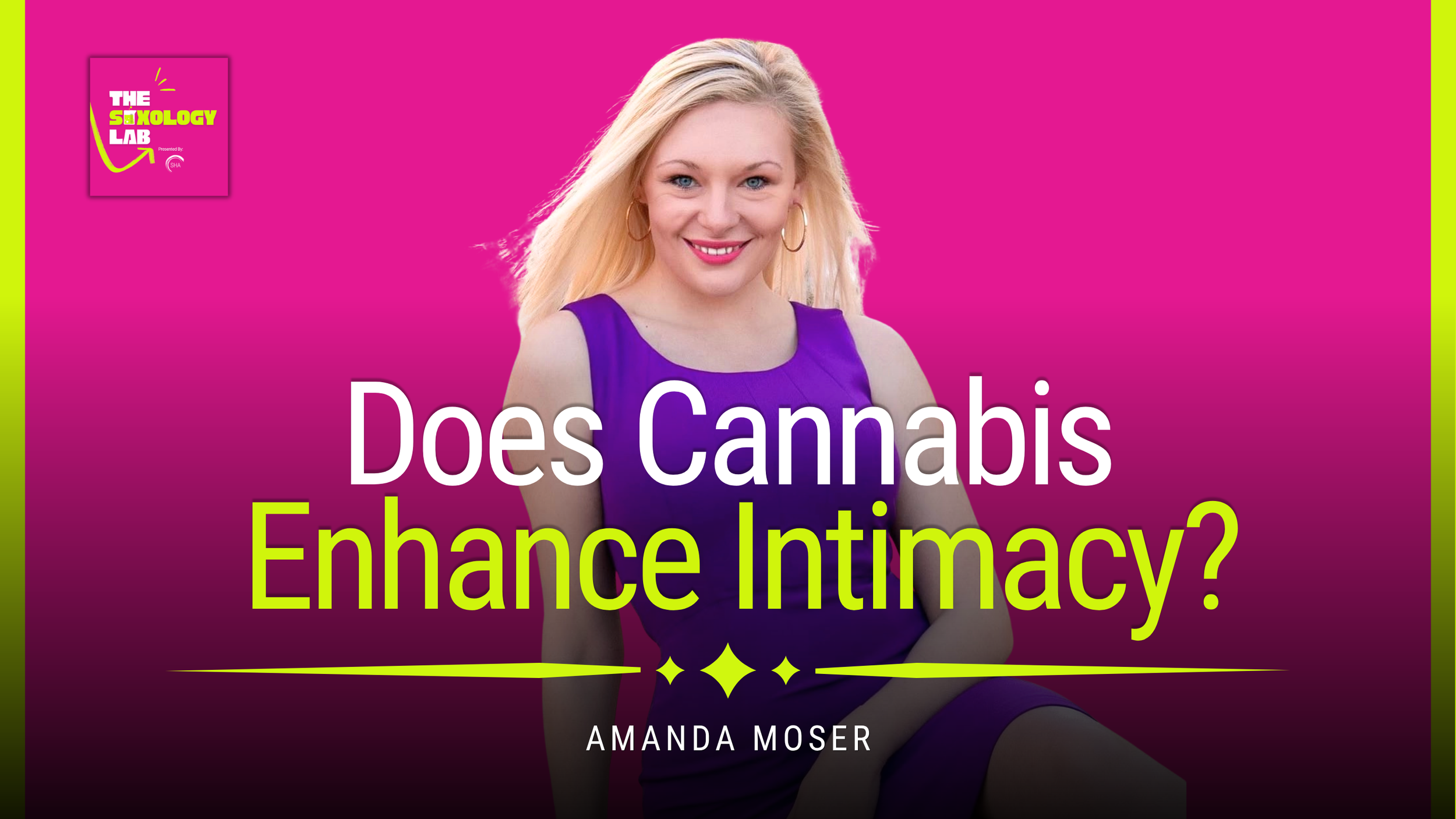
Can cannabis actually make orgasms more intense, increase sexual desire, and improve pleasure? Or have we been believing a popular myth about getting high and having sex?
For decades, people have shared stories about cannabis making sexual experiences feel more pleasurable. But scientific research exploring that connection has been surprisingly limited.
That's what inspired sexologist and researcher Amanda Moser to investigate.
Her nationwide study explored the relationship between cannabis use and sexual functioning, collecting responses from adults ages 18 to 85. The results suggested that many participants associated cannabis use with increased sexual desire, more intense orgasms, greater orgasm frequency, and improved sexual satisfaction.
But there's an important distinction: Reporting better sex after using cannabis isn't the same as proving cannabis causes better sex.
In Episode 37 of The Sexology Lab, host Michelle Melville-Kashon sits down with Amanda to explore what her research actually found, why cannabis and sexual pleasure remain understudied, and what scientists still need to understand.
They also discuss the orgasm gap, cannabis-infused lubricants, sexual performance anxiety, and the importance of being present during intimacy.
The biggest takeaway might surprise you. Sometimes improving your sexual experience has less to do with reaching orgasm and more to do with changing how you approach pleasure.
What This Episode Explores
"We found that cannabis definitely increased one's sexual desire" - Amanda Moser
In this conversation, Michelle and Amanda explore the intersection of cannabis, sexual functioning, and scientific research.
Topics include:
Whether cannabis use is associated with increased sexual desire.
What research suggests about cannabis and orgasm intensity.
Whether cannabis may influence orgasm frequency and masturbation pleasure.
How cannabis affects sensory experiences such as touch and taste.
What the research found about erections and sexual functioning.
Why dosage, tolerance, and consumption methods matter.
The difference between observational research and controlled clinical trials.
Whether cannabis could have future applications in sexual medicine.
Why cannabis research has faced significant legal and cultural barriers.
How focusing less on orgasm may improve sexual satisfaction.
Meet amanda moser
Amanda Moser is a sexologist, researcher, and educator whose work examines the relationship between cannabis use and sexual functioning.
Her academic journey began in biology, but an undergraduate human sexuality course introduced her to a field that would change her career.
During graduate school, she began thinking about two subjects that fascinated her: cannabis and sexuality.
At the time, she was studying in rural North Carolina, where cannabis laws and conservative attitudes created additional challenges for researching both subjects.
Amanda noticed that people frequently claimed cannabis improved their sexual experiences, yet relatively little contemporary scientific research explored those claims.
She decided to investigate.
In 2019, she conducted a nationwide survey examining cannabis use and several dimensions of sexual functioning.
The study eventually became one of the larger investigations of its kind, with respondents representing a broad range of ages and occupations.
Today, Amanda continues advocating for research that challenges stigma and helps professionals better understand the relationship between cannabis and sexual health.
3 Key Takeaways
"Then we found an increased ability to orgasm." - Amanda Moser
1. Cannabis Use Was Associated With Several Measures of Sexual Pleasure
Amanda's survey found that participants reported improvements in sexual desire, orgasm ability, orgasm intensity, orgasm frequency, masturbation pleasure, and overall sexual satisfaction associated with cannabis use.
Touch and taste were also among the sensory experiences participants reported as enhanced.
These findings are promising, but the research was based on self-reported experiences. It cannot establish whether cannabis directly caused the improvements.
2. Cannabis Doesn't Affect Everyone the Same Way
Amanda emphasizes that cannabis experiences vary according to factors such as individual tolerance, consumption method, amount used, and personal response.
Her findings also differed from some older research suggesting cannabis consistently interferes with erections.
The results reinforce why scientists need more controlled studies before making broad claims about cannabis and sexual functioning.
3. Sexual Pleasure Is About More Than Orgasm
One of Amanda's most important messages has nothing to do with cannabis.
She encourages people to stop treating orgasm as the only measure of a successful sexual experience.
Instead, she emphasizes sensation, connection, communication, and being present.
When orgasm becomes the only goal, people may overlook other forms of pleasure and intimacy.
Quick Answer: Does Cannabis Help You Orgasm?
Cannabis use has been associated with increased orgasm intensity, orgasm frequency, sexual desire, and sexual satisfaction in some self-report studies, but there is not enough clinical evidence to conclude that cannabis reliably improves orgasms.
In her nationwide study, sexologist Amanda Moser found that participants frequently reported more pleasurable sexual experiences when using cannabis, including greater ability to orgasm and enhanced sensory experiences.
However, the study relied on participant reports rather than a randomized, placebo-controlled experiment.
Cannabis can also produce unwanted effects, including anxiety, impaired judgment, and changes in coordination. Its effects vary between individuals and products.
More controlled research is needed to determine whether cannabis has a direct effect on orgasm, which populations might benefit, and what risks may accompany its use.
What Does Research Say About Cannabis and Sexual Pleasure?
"What we need to be doing is being more in the present moment." - Amanda Moser
Why Cannabis and Sex Have Been Understudied
When Amanda began reviewing scientific literature about cannabis and sexual functioning, she encountered an unexpected problem.
Much of the research she found dated back to the 1970s.
That created two challenges.
First, there were relatively few modern studies examining the connection between cannabis and sexual response.
Second, cannabis products have changed considerably over time.
Today's products can contain different concentrations of THC, and consumers may encounter a wider variety of formulations and consumption methods than were commonly available decades ago.
This makes it difficult to assume that findings from older research apply directly to contemporary cannabis use.
Amanda also faced challenges associated with researching a federally regulated substance.
Historically, legal restrictions and limited access to research-grade cannabis have complicated laboratory studies.
These barriers help explain why researchers have relied heavily on observational studies and surveys.
For broader information about cannabis research, visit the National Institute on Drug Abuse.
How Amanda Conducted Her Nationwide Study
Amanda recruited survey participants through social media, including Facebook groups.
Her goal was to reach people who had experience using cannabis and ask about their sexual functioning.
The study included adults between 18 and 85 years old.
Amanda was surprised by the diversity of respondents.
Participants reported working in a wide range of professions, including medicine, law, and law enforcement.
For Amanda, this helped challenge stereotypes about who uses cannabis.
The survey also examined several components of sexual functioning, rather than asking only whether participants thought cannabis made sex better.
These included sexual desire, orgasm, masturbation, satisfaction, and sensory experiences.
However, social media recruitment can introduce selection bias. People who choose to participate in a cannabis-related survey may differ from the broader population.
That matters when interpreting the findings.
Can Cannabis Increase Sexual Desire?
One of the findings Amanda discusses is the association between cannabis use and increased sexual desire.
Participants reported feeling more interested in sexual activity when using cannabis.
Sexual desire, often called libido, is influenced by numerous factors, including physical health, stress, relationship dynamics, medications, hormones, and emotional well-being.
Amanda suggests that relaxation and greater attention to physical sensations may help explain why some people report increased desire after using cannabis.
But this remains a hypothesis rather than a demonstrated mechanism from her survey.
Cannabis can also produce different experiences for different people.
Some individuals report relaxation, while others experience anxiety, discomfort, or reduced interest in sexual activity.
This means cannabis shouldn't be viewed as a universal solution for low libido.
For more expert conversations about the complexities of desire, explore The Sexology Lab's episode library.
Can Cannabis Make Orgasms More Intense?
What Amanda's Research Found About Orgasm Intensity
Amanda's survey examined whether participants perceived changes in their ability to orgasm and the intensity of their orgasms.
Respondents reported increased orgasm ability and more intense orgasm experiences associated with cannabis use.
Some also reported greater orgasm frequency, including multiple orgasms.
These findings were particularly interesting to Amanda because she had been studying differences in orgasm frequency between women and men.
She wanted to understand whether cannabis might be associated with changes in sexual response that could eventually inform research on orgasm difficulties.
However, there is an important limitation.
The survey didn't objectively measure orgasm intensity or establish whether cannabis caused changes in sexual response.
Instead, it captured participants' perceptions of their experiences.
Those perceptions are valuable for generating research questions, but they are not sufficient to establish a treatment effect.
Could Cannabis Help Close the Orgasm Gap?
The orgasm gap refers to documented differences in orgasm frequency between groups, particularly between heterosexual men and women during partnered sexual experiences.
These differences are influenced by multiple factors, including sexual practices, communication, knowledge of anatomy, and the types of stimulation involved.
Amanda explains that learning about the orgasm gap helped inspire her interest in cannabis research.
She wondered whether cannabis might influence orgasm ability or satisfaction.
Her findings suggest this is worth investigating further.
But cannabis isn't an established solution to the orgasm gap.
Improving sexual communication, understanding individual preferences, and recognizing the importance of appropriate stimulation remain central considerations.
Research into sexual pleasure should also avoid assuming that orgasm is necessary for every satisfying sexual experience.
Does Cannabis Improve Masturbation Pleasure?
Amanda made an important decision when designing her research.
She didn't want to study sexual experiences exclusively in the context of partnered sex.
Sexual arousal, pleasure, and orgasm can occur during masturbation as well.
Her survey therefore examined whether cannabis use was associated with changes in solo sexual experiences.
Participants reported increased masturbation pleasure associated with cannabis.
This finding matters because discussions about sexual functioning sometimes focus too heavily on partnered experiences.
Masturbation is another context in which people can explore their bodies, preferences, and responses to stimulation.
However, as with the other findings, the survey cannot establish a causal relationship.
The results identify a potential research direction rather than a proven benefit.
Why Might Cannabis Change How Sex Feels?
The Role of Relaxation and Being Present
Amanda believes that some reported changes in sexual pleasure may involve psychological factors.
She suggests that cannabis might help certain individuals relax or pay greater attention to physical sensations.
That could potentially influence how they experience intimacy.
But cannabis doesn't consistently produce relaxation, and some people experience increased anxiety or other unwanted psychological effects.
Amanda's study didn't isolate these possible mechanisms.
Still, her discussion raises an important question independent of cannabis:
How much does our ability to stay present influence sexual satisfaction?
Many people approach sex with expectations about what should happen.
They may worry about whether they will orgasm, whether their partner is enjoying the experience, or whether they are performing correctly.
That pressure can shift attention away from pleasure.
Amanda encourages people to recognize that orgasm doesn't have to be the central goal.
Sexual experiences can be meaningful and satisfying even when they don't end in orgasm.
Why Touch and Taste Stood Out in the Study
Amanda also investigated how cannabis use was associated with sensory experiences.
Among the five senses, touch and taste were the two she identified as showing particularly notable associations in her findings.
This is relevant because sensory experiences play a major role in intimacy.
Physical touch, kissing, and other sensations can influence arousal and connection.
Amanda's results suggest that altered sensory perception may be one factor worth exploring in future studies.
However, her survey didn't establish how cannabis changes sensory processing during sexual activity.
Researchers would need more controlled methods to understand those relationships.
Does Cannabis Cause Erectile Dysfunction?
Cannabis and erectile functioning have been debated for decades.
Amanda explains that some historical research suggested cannabis could interfere with achieving or maintaining erections.
Her own survey did not find the same consistent pattern.
She emphasizes that this doesn't mean cannabis can never contribute to erectile difficulties.
It means the relationship may be more complicated than some older claims suggest.
The study relied on self-reported information and couldn't establish how specific doses or products influenced erectile functioning.
Erections are also affected by many factors unrelated to cannabis, including cardiovascular health, stress, medications, fatigue, and relationship dynamics.
Persistent erectile difficulties should be discussed with a qualified healthcare professional.
The available evidence does not support recommending cannabis as a treatment for erectile dysfunction
What About Cannabis-Infused Lubricants?
During the episode, Amanda discusses cannabis-infused lubricants and topical products.
She describes the idea that applying cannabis-containing products directly to the body might produce localized effects.
However, claims that these products reliably increase genital blood flow, sensitivity, or orgasm intensity have not been established through adequate clinical trials.
Product formulations also differ.
THC, CBD, and other ingredients may have different properties, and topical absorption can vary.
Some products may contain ingredients that irritate sensitive genital tissue or affect compatibility with condoms and other barriers.
People should not assume that a product marketed for sexual wellness has been clinically tested for genital use.
For sexual-health professionals, this is an important distinction between emerging consumer products and evidence-based treatments.
Amanda's broader message is that researchers need to investigate these products more carefully.
Can Cannabis Help With Sexual Dysfunction or Pelvic Pain?
Cannabis and Female Orgasmic Disorder
Amanda discusses efforts to use emerging research to inform medical cannabis policy related to female orgasmic disorder.
Female orgasmic disorder involves persistent or recurrent orgasm difficulties that cause clinically significant distress, after relevant contextual factors are considered.
Amanda is interested in whether cannabis could eventually have a role in addressing some orgasm difficulties.
However, her observational research does not establish cannabis as an effective treatment.
Before clinical recommendations could be made, researchers would need studies evaluating efficacy, safety, appropriate populations, and potential risks.
For people experiencing distressing orgasm difficulties, assessment by a qualified sexual-health or medical professional can help identify contributing factors and appropriate care.
Cannabis, Endometriosis, and Pain
Amanda also shares her personal experience with endometriosis.
She describes living with severe pain and undergoing a hysterectomy in her twenties.
She says cannabis helped make her symptoms more manageable, although it didn't eliminate the pain.
Her experience highlights why researchers are interested in studying cannabis and chronic pain.
However, individual experiences do not establish effectiveness for endometriosis or pelvic pain.
Endometriosis is a complex medical condition that may require specialized treatment.
Anyone considering cannabis for symptom management should discuss potential risks, medication interactions, and evidence-based alternatives with a qualified healthcare professional.
Does the Type of Cannabis Matter for Sexual Pleasure?
THC, Dosage, and Individual Differences
Amanda repeatedly emphasizes that individual responses to cannabis can vary.
Factors discussed in the episode include:
The amount consumed.
Previous cannabis exposure and tolerance.
Method of consumption.
Product formulation.
Individual body chemistry.
The context in which cannabis is used.
These differences make it difficult to predict how a particular person will respond.
Higher-THC products can also increase the likelihood of unwanted effects, including anxiety, impaired coordination, and other health risks.
Cannabis use can impair attention, judgment, and reaction time, which is especially relevant when sexual activity requires clear communication and ongoing consent.
Amanda reports that respondents in her survey did not perceive cannabis as negatively affecting their sexual decision-making. That finding should not be interpreted as proof that cannabis has no effect on judgment or consent.
A person's ability to give informed, voluntary consent must always be respected. Sexual activity should not proceed when someone is too impaired to make or communicate decisions.
Indica vs. Sativa vs. Hybrid
Michelle and Amanda discuss whether different cannabis strains might produce different sexual experiences.
Amanda explains that her research couldn't reliably compare specific strains or quantify exactly how much cannabis participants consumed.
Some participants used multiple products or methods within the same period.
That made it difficult to isolate the effects of any particular formulation.
Although indica, sativa, and hybrid are commonly used consumer categories, those labels alone are not reliable predictors of a product's chemical composition or an individual's response.
Future research would benefit from measuring THC and CBD concentrations, dose, route of administration, and other product characteristics more precisely.
Smoking vs. Edibles: Does the Method Matter?
Amanda also discusses how consumption methods may influence cannabis experiences.
Inhaled cannabis and edible products can differ significantly in onset, duration, and intensity.
Edibles, in particular, can have delayed effects, making it easier for someone to consume more than intended before feeling the full impact.
These differences are relevant when designing research.
A study comparing cannabis products would need to account for how much was consumed, how it entered the body, and when effects occurred.
Amanda's survey couldn't answer whether smoking cannabis produces different orgasm outcomes than consuming an edible.
That remains an open research question.
For information about cannabis safety and its effects, visit the CDC's cannabis resource center.
What Does Science Still Need to Learn About Cannabis and Sex?
Amanda is enthusiastic about her findings, but she also recognizes the limitations of her research.
One of the biggest gaps is the lack of well-controlled clinical trials.
Self-report surveys can identify patterns and generate hypotheses.
They cannot determine whether a substance directly causes a particular outcome.
Future studies could investigate:
Whether cannabis directly affects orgasm ability or intensity.
How THC and CBD differ in their effects on sexual functioning.
Whether different doses produce different outcomes.
How consumption methods influence sexual experiences.
Whether cannabis affects sexual functioning differently across populations.
The relationship between cannabis, anxiety, and sexual performance.
Whether cannabis-based interventions have clinical benefits for specific conditions.
Potential adverse effects, including impairment, dependence, and unwanted psychological responses.
Randomized, placebo-controlled studies could help researchers separate the effects of cannabis from expectations, context, and other influences.
Amanda also discusses how legal restrictions and social media moderation can make this research difficult.
She encourages emerging researchers to continue investigating the subject rather than assuming the existing literature provides definitive answers.
Her work is an example of how asking an unconventional question can open an entirely new area of scientific inquiry.
What Sexual-Health Professionals Should Know
For sex therapists, educators, counselors, coaches, and medical professionals, the relationship between cannabis and sexual functioning presents both opportunities and challenges.
Some clients may already use cannabis in connection with sexual activity.
Others may ask whether it could improve desire, orgasm, or pain.
Professionals need to be prepared to discuss these questions without stigma while remaining grounded in the available evidence.
That means recognizing the difference between promising observational findings and clinically established treatments.
It also means understanding potential risks, individual health considerations, consent, and the legal context.
Amanda encourages professionals to explore the literature and remain open to new research.
Sexual-health education continues to evolve as researchers investigate previously overlooked aspects of pleasure, behavior, and intimacy.
Organizations such as Sexual Health Alliance provide professional education across a wide range of sexuality-related subjects, helping practitioners develop the knowledge needed to navigate complex conversations.
Frequently Asked Questions About Cannabis and Sexual Health
Can cannabis make orgasms stronger?
Some observational research, including Amanda Moser's nationwide survey, has found that participants report greater orgasm intensity associated with cannabis use. However, controlled clinical research is needed to determine whether cannabis directly causes stronger orgasms.
Does cannabis increase libido?
Some people report increased sexual desire after cannabis use, but responses vary. Cannabis can also cause anxiety, fatigue, or other effects that may interfere with sexual interest. It is not an established treatment for low libido.
Can cannabis help women orgasm?
Amanda's research found associations between cannabis use and increased orgasm ability and frequency, including among women. These findings are preliminary and do not establish cannabis as a treatment for female orgasmic disorder.
Does cannabis make sex feel better?
Some survey participants report improved sexual satisfaction and enhanced sensory experiences after using cannabis. Others may experience unwanted effects. The evidence does not support assuming that cannabis improves sexual experiences for everyone.
Can cannabis cause erectile dysfunction?
Research findings are mixed. Amanda's survey did not identify the consistent erectile difficulties described in some older studies, but it cannot rule out negative effects. Persistent erectile concerns should be evaluated by a healthcare professional.
Does cannabis affect sexual consent?
Cannabis can impair attention, judgment, and decision-making, particularly at higher levels of intoxication. Clear, informed, voluntary, and ongoing consent is essential. Someone who is significantly impaired may be unable to provide valid consent.
Are cannabis-infused lubricants effective?
There is insufficient clinical evidence to establish that cannabis-infused lubricants reliably improve arousal, orgasm, or sexual satisfaction. Product safety and genital compatibility also require consideration.
What is the best cannabis strain for sex?
There is no scientifically established best cannabis strain for sexual pleasure. Individual responses vary, and common labels such as indica, sativa, and hybrid do not reliably predict sexual outcomes.
Is cannabis an approved treatment for sexual dysfunction?
Cannabis is not an established, broadly approved treatment for sexual dysfunction. Research into possible clinical applications is ongoing, and medical cannabis laws and qualifying
Listen to the Episode
Amanda Moser | Episode 37
Can cannabis actually improve sexual pleasure, or are we confusing personal experiences with scientific evidence?
Join Michelle Melville-Kashon and sexologist Amanda Moser as they explore the research behind cannabis, sexual desire, orgasm intensity, masturbation, and sexual satisfaction.
Amanda shares what her nationwide study found, the challenges of researching two highly stigmatized subjects, and why scientists still have so much to learn about cannabis and sexual functioning.
Explore Episode 37 and more conversations on The Sexology Lab.
Related Sexology Lab Conversations
Why You're Not in the Mood and There's Nothing Wrong With You | Dr. Nazanin Moali
Explore how desire works, why libido changes, and how psychological factors influence sexual experiences.
What's It Like to Be a Sex Coach in Hong Kong? | Irene Chung
Discover how sexual shame, performance expectations, and cultural beliefs influence pleasure and intimacy.
Explore More Conversations About Sexual Pleasure and Research
Hear from leading researchers, clinicians, and educators investigating the science of sexuality, relationships, and human behavior.
Additional Resources
National Institute on Drug Abuse: Cannabis — Scientific information about cannabis, its effects, and ongoing research.
CDC: Cannabis and Public Health — Public-health guidance on cannabis use, impairment, and potential risks.
PubMed — Peer-reviewed research examining cannabis and sexual functioning.
The Kinsey Institute — Research on human sexuality, sexual behavior, and relationships.
World Health Organization: Sexual Health — Information about sexual well-being and its physical, psychological, and social dimensions.
Sexual Health Alliance — Professional education and certification programs in sexual health.
About Our Sponsor: Sexual Health Alliance
The Sexology Lab is sponsored by Sexual Health Alliance, a global leader in professional sexual-health education since 2015.
SHA offers certification programs in sex therapy, sex coaching, sexuality counseling, sex education, and sexology.
Through education from leading experts, immersive learning experiences, and a global professional community, SHA helps professionals build the knowledge, skills, and connections needed to advance sexual health.
Conversations like this episode with Amanda Moser demonstrate why ongoing research and education are essential for understanding emerging topics in sexual health.
From sexual pleasure and orgasm research to intimacy, relationships, and clinical practice, SHA prepares professionals to approach sexuality with curiosity, scientific knowledge, and respect for diverse experiences.
Interested in pursuing a career in sexual health?
Explore Sexual Health Alliance's certification programs.
Want More Conversations Like This?
If you want deeper, research driven conversations about sex, relationships, and culture, join the Sexology Lab newsletter. Get expert insights, real world perspectives, and conversations that challenge outdated thinking and replace them with something more useful.
Visit SexologyLab.com to explore more episodes and stay connected.
About The Sexology Lab
The Sexology Lab explores the intersection of sexual health, psychology, and culture. Through expert conversations, we challenge outdated narratives and provide research driven insights into relationships, desire, and human behavior.
