
Netflix Wanted the "Sexy Girl." She Became a Sex Educator Instead. | Alyssa Ljubicich | Episode 30
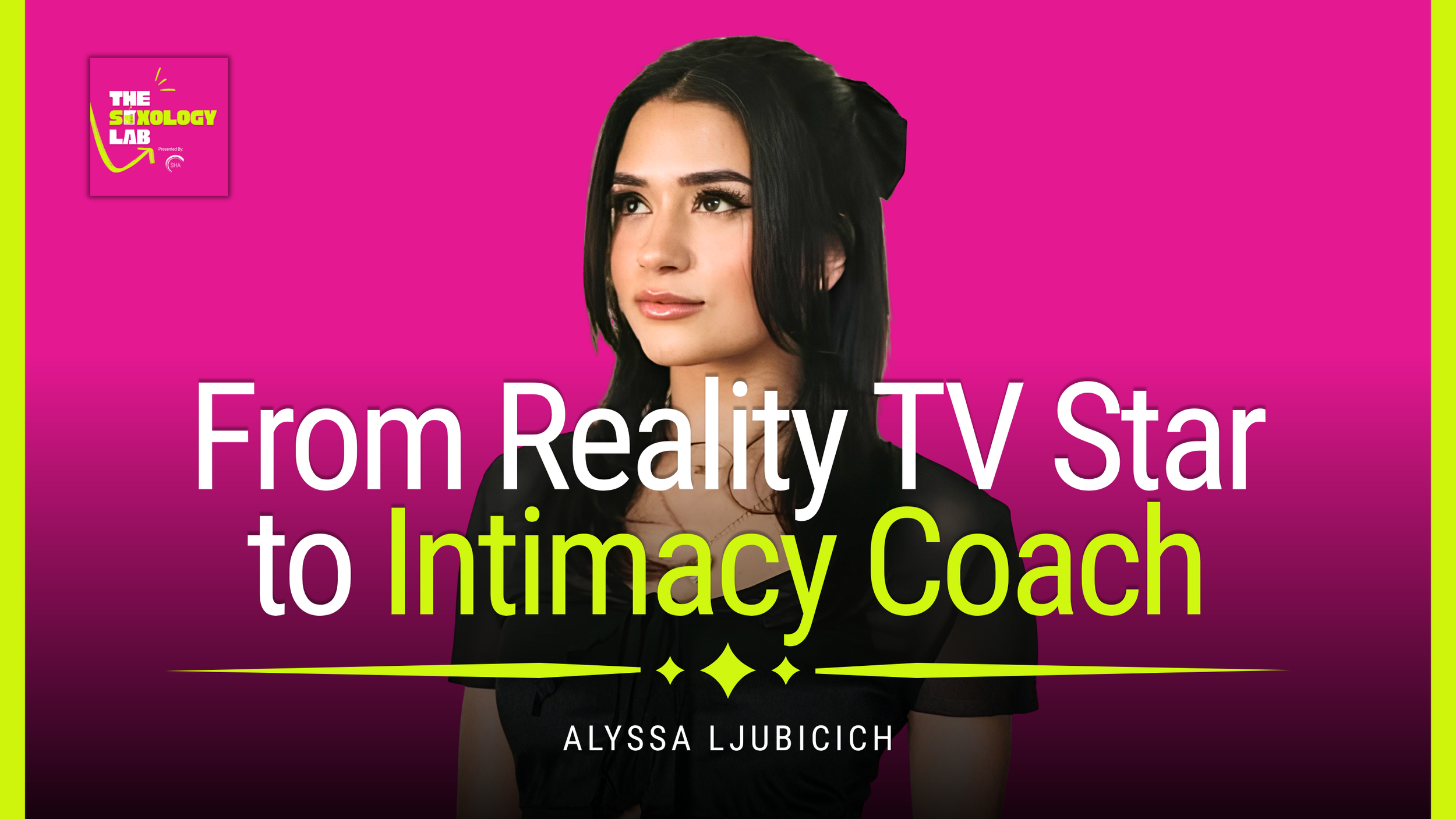
When Alyssa Ljubicich joined Netflix's The Circle, producers thought they knew the character she would play.
The "sexy girl."
She worked in sexual health. She talked openly about sexuality. She even arrived with a vulva pillow.
But there was a problem.
That wasn't who Alyssa was.
Behind the reality-TV storyline was someone becoming increasingly serious about sexual-health education, professional training, research, and helping people understand their bodies without shame.
In this episode of The Sexology Lab, Alyssa explains how an unexpected reality-TV opportunity became a platform for an entirely different career—and what the experience taught her about the difference between talking professionally about sexuality and being sexualized yourself.
What This Episode Explores
"Certifications matter. Training matters. Experience matters." — Alyssa Ljubicich
Alyssa's story sits at an unusual intersection of reality television, sexual-health education, social media, coaching, entertainment, and entrepreneurship.
But underneath all of those experiences is one recurring question:
Who teaches us what to believe about sexuality?
Sometimes it's our families.
Sometimes religion.
Sometimes school.
Sometimes social media.
And sometimes it's a movie we watched when we were 15 without realizing it was teaching us anything at all.
It's a question that comes up repeatedly on The Sexology Lab. In Education Forgot the Fun Part, Amy Baldwin and April Lampert explore what traditional sex education leaves out, including pleasure, emotional safety, and understanding our own bodies. And in Who Taught You About Pleasure?, Laura Ramadei examines how adult media can become an unofficial form of sex education.
Alyssa brings another layer to that conversation: what happens when the person doing the educating is also being turned into a sexualized character?
Guest Introduction
"I didn't even know it was available to dream about." — Alyssa Ljubicich
Alyssa Ljubicich is a sex educator, coach, content creator, and Sexual Health Alliance-certified sexologist whose career has included reality television, a TEDx Talk, sexual-wellness brands, coaching, and educational media.
Many people first discovered Alyssa when she appeared on Netflix's The Circle.
But while reality television dramatically expanded her platform, her professional interest in sexual health had already begun.
In 2020, Alyssa started assisting a somatic sex coach and saw firsthand how sexuality-focused work could change people's lives.
When Netflix later gave her a larger public platform, she made a deliberate decision: she didn't want to become another person sharing sexual-health information online without the education to support it.
She pursued formal education through Sexual Health Alliance and began building the career she has today.
Her TEDxUCDavis talk, The Power in Pleasure, later brought many of those ideas together, exploring women's pleasure, sexual shame, cultural history, and the importance of understanding our bodies.
Interested in turning an interest in sexuality into a profession? SHA's Careers in Sexual Health guide explains the differences between careers in therapy, coaching, counseling, education, research, sexology, media, and sexual wellness.
3 Key Takeaways
Talking about sexuality professionally does not mean someone wants to be sexualized personally. Alyssa's reality-TV experience showed her how quickly people can collapse those two identities—and why sexual-health professionals may need to actively define how they want their work represented.
Media is part of our sexual education. Movies, television, reality TV, social media, and entertainment all contribute to what we learn about gender, pleasure, relationships, bodies, and what sexual behavior is considered acceptable.
Sexual-health information needs credible experts. Alyssa describes what she calls the "death of the expert" online and argues that training, research, certification, scope of practice, and knowing when to refer someone elsewhere are increasingly important.
Who This Episode Is For
Sex educators and sexual-health professionals
People considering a career in sexual health
Coaches and content creators
Reality-TV fans
Anyone interested in media and sexuality
People unlearning purity-culture messages
Sexual-health students
Creators interested in working with sexual-wellness brands
Anyone wondering how much movies, television, and social media influence what we believe about sexuality
In This Episode, We Cover
How Alyssa went from Netflix reality TV to sex education
Why she pursued professional sexual-health training
The "death of the expert" on social media
Being cast as the "sexy girl"
The difference between sexual-health education and personal sexualization
Meeting the Spice Girls
Common misconceptions about sexual-health careers
Sexuality and cultural conditioning
Purity culture
Alyssa's TEDx Talk, The Power in Pleasure
The hymen and virginity myth
How movies influence sexual expectations
Media literacy and sexual health
Pleasure and empowerment
Becoming a Playboy advisor
Working with sexual-wellness brands
Social media as a professional portfolio
Knowing your scope of expertise
Alyssa's Sexual Health Alliance education
Building community in the sexual-health field
How to build a credible career as a sex educator
Quick Answer
How did Alyssa Ljubicich become a sex educator after Netflix?
Alyssa Ljubicich was already working as an assistant to a somatic sex coach before appearing on Netflix's The Circle. That experience introduced her to sexual-health work and showed her that helping people explore sexuality could become a meaningful career.
After gaining a public platform through reality television, Alyssa decided she wanted professional education behind the information she shared.
She enrolled with Sexual Health Alliance and says her training became the educational foundation for her work as a sex educator and coach.
Today, her career combines sexual-health education, coaching, social media, brand partnerships, and public speaking.
Do you need training to become a sex educator?
There are different professional paths within sexual health, and requirements depend on the role and where someone practices.
Sex therapists, sexuality counselors, sex coaches, sex educators, and sexologists do not all have the same education, licensure, certification, or scope of practice.
That's one reason understanding the differences between sexual-health careers matters. SHA's Careers in Sexual Health guide provides a detailed comparison of these career paths.
Expanded Insight
"It's a career path that really is about giving." — Alyssa Ljubicich
Netflix Wanted a Character. Alyssa Wanted a Career.
Reality television works through characters.
The flirt.
The villain.
The sweetheart.
The troublemaker.
When Alyssa joined The Circle, she quickly realized producers had an idea of who she would be.
She worked in sexual health, so they expected sexuality to become part of her character.
Even the clothing selected for her introduction made Alyssa realize how she was being positioned.
She remembers thinking:
They want me to be the "sexy sex girl."
But Alyssa had already begun developing a professional separation between her own sexuality and the sexuality she discussed through her work.
Teaching about sex wasn't an invitation to sexualize her.
It was her job.
And that distinction became increasingly clear as filming continued.
The Reality-TV Role She Wouldn't Play
Eventually, an executive producer confirmed what Alyssa had suspected.
They thought she was going to be the flirt.
But she hadn't played along with that storyline.
The experience taught Alyssa an important lesson that would follow her into her professional career:
You may not be able to control how everyone perceives you, but you can make choices about the identity you reinforce.
That's particularly relevant for people working in sexual health.
Sex therapists, coaches, educators, researchers, and sexologists spend their careers discussing subjects that many people still consider private or taboo.
That doesn't make the professional personally available for sexualization.
It also doesn't mean sexual-health work is inherently provocative.
For Alyssa, the work is about helping other people find healing, excitement, exploration, knowledge, and empowerment in their own sexuality.
What Does a Sex Educator Actually Do?
The misunderstanding Alyssa experienced on television reflects a larger misunderstanding of sexual-health careers.
She says people still incorrectly refer to her as a sex therapist.
And she still encounters people who assume sex therapists have sexual contact with their clients.
These misconceptions collapse very different professions into one vague idea of "working with sex."
In reality, sexual health includes numerous professional pathways.
A sex therapist, sexuality counselor, sex coach, sex educator, sexologist, researcher, physician, pelvic-health professional, and other sexuality-focused professional may have very different education, credentials, responsibilities, and scopes of practice.
SHA's Careers in Sexual Health resource provides a breakdown of these different professional paths.
We Are Surrounded by Sexuality—and Still Know Very Little About It
Alyssa describes a contradiction at the heart of American culture.
Sexuality is everywhere.
Advertising uses it.
Entertainment uses it.
Social media uses it.
But basic sexual-health knowledge can still be remarkably difficult to access.
People may grow up being told to avoid sexual experience and then enter a long-term relationship where they're suddenly expected to know exactly what they're doing.
As Alyssa points out, those expectations don't make much sense.
How is someone supposed to arrive at sexual confidence without ever being allowed to learn, communicate, explore, or ask questions?
This is closely connected to a conversation Amy Baldwin and April Lampert have in Education Forgot the Fun Part, where they examine how conventional sex education often focuses on risk while leaving out pleasure, communication, emotional safety, and practical knowledge about our bodies.
Your Beliefs About Sexuality Didn't Begin With You
A major theme in Alyssa's TEDx Talk, The Power in Pleasure, is that our sexual beliefs have histories.
What feels like a deeply personal belief may have been shaped by cultural ideas that existed for generations before us.
Alyssa asks people to zoom out.
What messages have societies historically communicated about women's bodies?
Who was allowed to experience pleasure?
Whose sexuality was controlled?
What was considered "pure"?
Who got to decide?
And what traces of those ideas remain today?
This perspective can be particularly useful when examining purity culture.
People don't develop beliefs about virginity, sexual partners, pleasure, or "respectability" in isolation.
They inherit messages.
Understanding where those messages came from can make it easier to decide whether we actually want to keep them.
The Hymen Cannot Tell You Whether Someone Has Had Sex
One of the sexual-health myths Alyssa says generates the strongest reactions online involves the hymen.
Many people were taught that the hymen is essentially a seal that "breaks" during someone's first vaginal intercourse—and that bleeding therefore proves virginity.
That is not medically accurate.
The World Health Organization's statement on virginity testing explains that hymen appearance is not a reliable indicator of intercourse and that there is no known examination that can prove a history of vaginal intercourse.
Planned Parenthood's guide to virginity and the hymen also explains that hymenal tissue varies between people and can stretch for reasons unrelated to vaginal intercourse.
For Alyssa, the fact that adults are still discovering this information illustrates exactly why sexual-health education matters.
Some myths survive not because they're scientifically supported, but because they've been culturally repeated for so long that they begin to feel like facts.
Movies Were Teaching Us About Sexuality the Whole Time
Think about the movies you watched as a teenager.
You probably didn't call them sex education.
But they were teaching you something.
Alyssa points to popular films from the late 1990s and early 2000s as examples of how sexual expectations become normalized through entertainment.
Male characters could pursue pleasure, masturbate, seek casual encounters, or manipulate their way into romantic situations while audiences were invited to laugh along.
Female sexuality frequently operated under a different set of rules.
Those movies didn't invent cultural sexual scripts.
But they reinforced them.
That's why media literacy is part of sexual-health literacy.
We can enjoy a movie and still ask:
What is this teaching us?
Who gets to experience pleasure?
Whose desires matter?
What behavior is being rewarded?
What is being played for laughs?
Would we interpret this storyline differently if the genders were reversed?
Adult Media Is Teaching Us Too
This isn't limited to Hollywood movies.
When formal education leaves gaps, people often turn to other forms of media to learn what bodies, pleasure, orgasm, and intimacy are "supposed" to look like.
In Who Taught You About Pleasure?, sexologist Laura Ramadei explores how adult media can shape expectations around performance, bodies, orgasm, and communication—and what happens when people carry those scripts into their real relationships.
Arthur Brun takes the conversation behind the camera in The Camera Has a Point of View, examining how the people creating adult media influence what audiences ultimately see.
And intimacy coordinator Jamie Monahan explores the same question from mainstream film and television in What Really Happens When Actors Film Intimate Scenes?.
Together, these conversations raise an important question:
If media is going to teach people about intimacy whether we intend it to or not, what do we want it to teach?
Better Media Can Teach Something Different
Alyssa sees signs of change.
She points to newer entertainment where characters talk about trust, pleasure, communication, and sexuality in ways that would have been unusual in mainstream programming a generation ago.
That matters because media doesn't simply reflect culture.
It participates in culture.
When audiences repeatedly see intimacy portrayed without communication, that can become part of their expectation for how intimacy works.
When they see characters communicate openly, prioritize trust, ask questions, or care about another person's pleasure, they encounter a different model.
It's a theme that also comes up in The Sexology Lab's conversation with Dr. Tara Suwinyattichaiporn, Why Is It So Hard to Talk About?, which explores why so many adults were never given the language to communicate about sexuality in the first place.
Neither television nor social media should replace comprehensive sexual-health education.
But pretending entertainment has no educational effect ignores how people actually learn about sexuality.
The "Death of the Expert"
Social media has made sexual-health information easier to access than ever.
It has also made credentials harder to see.
An evidence-based educator and an influencer repeating misinformation can appear one swipe apart.
They can use the same camera.
The same trending audio.
The same confident tone.
The same polished graphics.
That's why Alyssa worries about what she calls the "death of the expert."
Being compelling doesn't make someone qualified.
Being viral doesn't make something true.
And having a large audience doesn't eliminate the responsibility to understand your own scope.
Alyssa says certifications, education, professional experience, and research matter.
So does being willing to say:
I don't know.
Or:
That's outside my scope.
That may not be the most viral answer.
But it can be the most responsible one.
Social Media Can Also Become Your Living Résumé
There is another side to social media.
For professionals building a career, Alyssa sees a profile as a kind of public portfolio.
Brands can see:
What do you know?
How do you communicate?
What topics do you cover?
Can you explain complex information clearly?
What does your content look like?
Where is your expertise?
That's particularly important for educators hoping to work with sexual-wellness companies.
Alyssa explains that brands often operate through predefined campaigns and budgets. Instead of simply pitching constantly, creators can benefit from developing a body of work that makes their expertise obvious when the right opportunity appears.
But expertise remains the operative word.
Alyssa gives a straightforward example: she wouldn't accept an assignment educating people about menopause or perimenopause simply because a company offered it.
That's not her area.
Someone else knows more.
Knowing when you're not the expert is part of being a credible expert.
From Playboy to Sexual-Wellness Brands
Alyssa's career now crosses education, coaching, social media, and brand work.
She has served as a Playboy advisor and partnered with sexual-wellness companies while maintaining the educational identity she worked hard to establish after reality television.
Her goal isn't simply to promote products.
Part of it is normalization.
Seeing lubricant or a pleasure product appear in someone's feed as naturally as other wellness products can help make sexuality feel like an ordinary part of human life rather than something that must always be hidden or treated as scandalous.
For Alyssa, that normalization is part of the larger mission.
Why Alyssa Chose Sexual Health Alliance
When Alyssa suddenly had a platform, she knew she wanted education behind it.
She chose Sexual Health Alliance because she didn't want to contribute to the exact problem she now sees across social media: people speaking with authority without the knowledge to support it.
Her SHA experience included coursework, Sexual Attitude Reassessment (SAR), events, community, and opportunities to connect with other professionals in the field.
She describes the community as one of the most valuable pieces.
She also emphasizes the importance of continually updated education.
Sexual-health knowledge evolves.
Language evolves.
Research evolves.
Professional standards evolve.
Education in this field can't simply stop once someone receives a certificate.
For anyone considering entering the field, SHA's Careers in Sexual Health guide is a useful starting point for understanding the different pathways available.
You Don't Have to Know Everything to Be Credible
One of the most valuable things Alyssa says her education gave her isn't an answer to every question.
It's knowing where her knowledge ends.
She regularly answers live questions without knowing in advance what someone will ask.
Her education gives her a foundation for responding.
But it also gives her something equally important:
The ability to recognize when a question falls outside her scope.
That's an underrated professional skill.
Good sexual-health education shouldn't create professionals who believe they know everything.
It should create professionals who understand what they know, what they don't know, how to evaluate evidence, and when another professional is better equipped to help.
A Career Alyssa Didn't Know She Could Dream About
Alyssa didn't grow up imagining she'd become a sex educator.
She didn't imagine she'd appear on Netflix.
She didn't imagine she'd meet the Spice Girls.
She didn't imagine she'd give a TEDx Talk.
At one point in the conversation, she explains that these weren't dreams she had abandoned.
She simply didn't know they were possibilities.
That's an important idea for anyone considering a less traditional career in sexual health.
The field is much larger than many people realize.
There are therapists.
Educators.
Researchers.
Coaches.
Counselors.
Sexologists.
Healthcare professionals.
Writers.
Content creators.
Consultants.
And professionals building careers that don't fit neatly into any one category.
Sometimes the first step isn't knowing exactly where you're going.
It's realizing the career exists.
Listen to the Episode
Listen to Netflix Wanted the "Sexy Girl." She Became a Sex Educator Instead. | Alyssa Ljubicich | Episode 30 on The Sexology Lab for the full conversation about reality television, sexualization, sex education, pleasure, media literacy, sexual-health myths, social media, and building a credible career in sexual health.
Explore more episodes of The Sexology Lab or listen wherever you get your podcasts.
Want More Conversations Like This?
If you want deeper, research driven conversations about sex, relationships, and culture, join the Sexology Lab newsletter. Get expert insights, real world perspectives, and conversations that challenge outdated thinking and replace it with something more useful.
About The Sexology Lab
The Sexology Lab explores the intersection of sexual health, psychology, and culture. Through expert conversations, we challenge outdated narratives and provide research driven insights into relationships, desire, and human behavior.
