
The Menopause Study That Had Women Self-Pleasuring 3–4 Times a Week | Dr. Justin Lehmiller | Episode 31
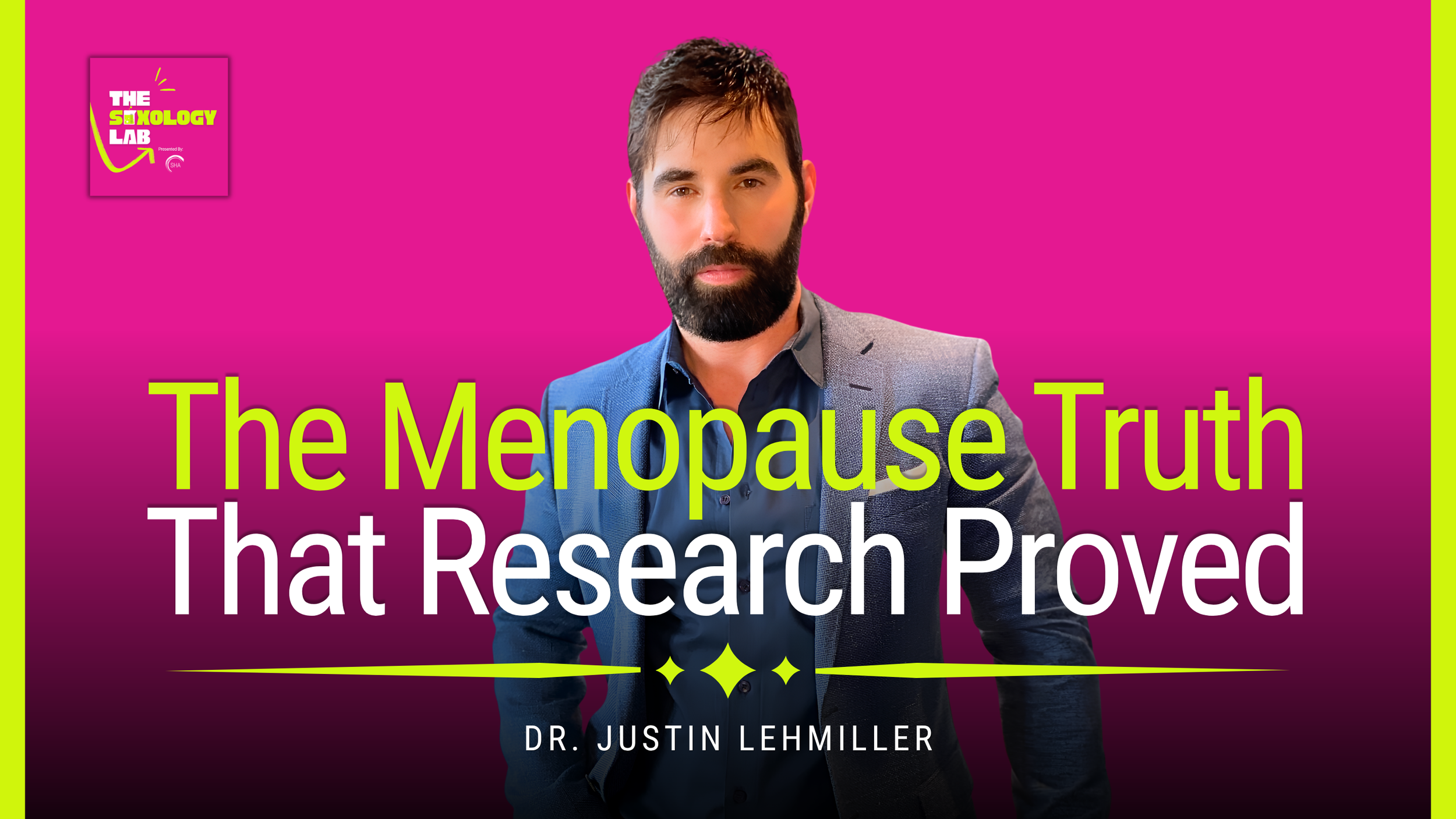
What happens when researchers ask women experiencing menopause to masturbate three to four times a week for several months?
Dr. Justin Lehmiller and his research team decided to find out.
Their research explored a surprisingly understudied question: Could masturbation and orgasm play a role in managing some of the symptoms associated with menopause?
The results don't mean masturbation is a cure for menopause—or that everyone should be aiming for a specific number of orgasms every week.
But they do suggest something important.
Pleasure may deserve a more serious place in conversations about menopause and women's health.
What This Episode Explores
"The trajectory for sexual pleasure isn't the same for everyone." — Dr. Justin Lehmiller
Menopause and masturbation have something in common: historically, neither has received nearly as much open conversation or research as it deserves.
Put them together and the research becomes even thinner.
Dr. Justin Lehmiller describes this as the intersection of two historically taboo subjects. Research funding has also tended to favor the risks and negative outcomes associated with sexuality rather than pleasure itself.
That's beginning to change.
In this episode of The Sexology Lab, Justin takes us inside research examining masturbation among pre-, peri-, and post-menopausal women—and a follow-up study that asked participants to engage in self-pleasure three to four times per week.
The conversation expands beyond masturbation to explore orgasm, sleep, mood, desire, hormone therapy, sexual health and aging, vibrator myths, healthcare education, and why our definition of pleasure may need to evolve as our bodies do.
It's a theme we've explored elsewhere in The Lab. In The Science Behind SexTech for Pelvic Pain, biomedical engineer Dr. Soum Rakshit discusses how sexual-health technology is increasingly being studied alongside traditional healthcare approaches for concerns including menopause, pelvic pain, and sexual function.
Guest Introduction
"We are sexual beings for our entire lives." — Dr. Justin Lehmiller
Dr. Justin Lehmiller is a social psychologist and sexuality researcher whose work explores sexual fantasies, desire, relationships, and human sexuality.
His latest research has taken him into an area he didn't originally expect to study: menopause.
The project began when sexual-health company Womanizer provided funding for research examining masturbation and menopause. Justin brought Dr. Cynthia Graham of the Kinsey Institute onto the project because of her established expertise in menopause research.
What began as an unexpected research opportunity has grown into an ongoing collaboration involving multiple studies and grants.
Justin is also the director of Sexual Health Alliance's Study Abroad programs, where students and professionals explore sexuality, culture, history, research, and sexual health through immersive international education.
3 Key Takeaways
"Sex doesn't have like this definitive expiration date." — Dr. Justin Lehmiller
Menopause does not automatically mean losing your sexuality. Sexual frequency may decline for some people, but Justin's research did not find an across-the-board decline in orgasm. Some post-menopausal participants even reported that orgasms became easier or improved over time.
Regular self-pleasure was associated with improvements in several menopause symptoms. In the longitudinal study, participants were asked to masturbate three to four times per week. Researchers observed decreases in how frequent or bothersome several symptoms were, particularly difficulties with sleep and concentration, mood, and irritability.
Masturbation isn't a replacement for menopause treatment. Justin emphasizes that self-pleasure may be one accessible addition to individualized menopause care—not a substitute for medical evaluation, hormone therapy, or other treatments when those are appropriate.
Who This Episode Is For
Women approaching perimenopause
People currently navigating menopause
Anyone curious about masturbation and health
Healthcare professionals treating midlife patients
Sex therapists, educators, counselors, coaches, and sexologists
Partners who want to better understand menopause
Anyone experiencing changes in desire, orgasm, or sexual function with age
People interested in the science of pleasure
Anyone who has wondered whether sexuality really declines after menopause
In This Episode, We Cover
Can masturbation help menopause symptoms?
What happens to orgasm after menopause?
Why women's masturbation has been so understudied
The study that asked women to masturbate three to four times per week
Which menopause symptoms appeared to improve
Why orgasm and sleep may be connected
Whether participants had to orgasm during the study
What happened when participants tried a new vibrator
Can vibrators desensitize the clitoris?
Why erotic flexibility may matter
How sexual pleasure changes with age
Why some women report better orgasms after menopause
Sexual health and medical education
How doctors can talk about pleasure
Hormone therapy and menopause
Why menopause doesn't mean the end of sexuality
Sexual health and aging
Dr. Justin Lehmiller's upcoming neuroscience research
SHA Study Abroad and learning about sexuality across cultures
Menopause and Masturbation Quick Answer
Can masturbation help with menopause symptoms?
Emerging research suggests it may help some people.
In Dr. Justin Lehmiller and colleagues' research, regular masturbation was associated with reductions in how frequent or bothersome several menopause symptoms were. Participants were asked to masturbate three to four times per week over a period of months, and researchers observed improvements across multiple symptoms, particularly sleep difficulties, concentration, mood, and irritability.
The researchers also found that participants who orgasmed more consistently tended to show greater symptom improvement.
That does not mean masturbation has been proven to treat menopause or that three to four times per week is the ideal frequency for everyone. Justin specifically cautions against turning the study protocol into a universal prescription.
You can read the published research, The Role of Masturbation in Relieving Symptoms Associated With Menopause, for a deeper look at the findings.
Does menopause make orgasms worse?
Not necessarily.
Justin's research found substantial variation. Although sexual and masturbation frequency tended to decline with age, post-menopausal participants did not universally report having fewer orgasms.
Some women actually reported that their orgasms had improved or become easier over time.
The Menopause Society's sexual-health guidance similarly emphasizes that there is no single "normal" trajectory for desire during midlife. Some people experience declining interest, others experience increased interest, and others notice little change.
Expanded Insight
Why Hasn't Anyone Studied Masturbation and Menopause?
Menopause research has expanded dramatically, but pleasure has often been missing from the conversation.
Justin sees several reasons.
For decades, menopause itself wasn't openly discussed.
Neither was women's masturbation.
Research funding creates another obstacle.
Studies examining sexually transmitted infections, dysfunction, disease, or other negative outcomes have traditionally had clearer pathways to funding than research asking questions about pleasure.
That leaves researchers with surprisingly little empirical information about something millions of people experience.
What role might self-pleasure play during menopause?
Justin and his colleagues decided to start finding out.
The First Study Asked What Women Were Already Doing
The researchers began with a nationally representative survey of peri- and post-menopausal women.
They wanted to understand whether women were already using masturbation as a form of menopause self-care—and whether those women believed it helped.
One of the findings immediately challenged a common stereotype about aging.
Yes, masturbation and sexual frequency tended to decrease with age.
But orgasm didn't follow the same simple trajectory.
There wasn't an across-the-board decline.
Some post-menopausal women actually reported that orgasms had improved or become easier.
That distinction matters because aging and sexuality are often discussed as though sexual decline is inevitable.
It isn't that simple.
As Justin puts it:
"The trajectory for sexual pleasure isn't the same for everyone."
Menopause May Bring Sexual Freedom Too
The cultural narrative around menopause tends to emphasize loss.
Loss of hormones.
Loss of fertility.
Loss of desire.
Loss of youth.
But Justin's research also asked women whether anything positive had come from menopause.
For some, the answer was yes.
One example was freedom from anxiety about unintended pregnancy.
For those women, menopause could introduce a new kind of sexual freedom.
That doesn't erase difficult symptoms.
It does challenge the assumption that menopause is inherently the beginning of a worse sexual life.
Sexuality changes throughout our lives.
Change and decline aren't necessarily the same thing.
Then Researchers Asked Women to Masturbate 3–4 Times a Week
The next study moved beyond asking women what they were already doing.
Researchers followed participants over several months.
The study began with an abstinence period in which participants did not masturbate.
Then they were asked to masturbate regularly—specifically, three to four times per week.
Participants went through different phases using their preferred masturbation method and a specific clitoral suction vibrator. During the final phase, they could choose whether to continue using the device or return to another method.
Throughout the study, researchers tracked menopause symptoms.
They also had participants complete "pleasure journals" after masturbating, documenting information such as whether they had an orgasm and what type of stimulation they used.
And something interesting happened.
As masturbation frequency remained relatively high, menopause symptoms tended to decrease.
Which Menopause Symptoms Improved?
The researchers saw improvements across more areas than they expected.
Justin says some of the most notable changes involved:
Sleep difficulties
Concentration
Mood
Irritability
The research also examined other experiences associated with menopause and sexual function.
The breadth of the changes surprised the research team.
They had expected effects to be more localized.
Instead, they began considering whether one factor might help explain some of the broader changes.
Orgasm.
Why Might Orgasm Matter During Menopause?
Women who orgasmed more consistently tended to show the greatest improvement in symptoms.
One possible explanation Justin discusses is sleep.
Orgasm is associated with physiological changes that can support relaxation and sleep. Better sleep can then affect how someone feels the following day.
That matters because sleep disruption can compound other difficulties.
Poor sleep can affect concentration.
It can affect mood.
It can make irritability worse.
And feeling chronically exhausted can influence sexual desire and overall wellbeing.
In other words, some of the apparent benefits may not come from masturbation acting directly on every individual menopause symptom.
Instead, improved sleep and mood may create downstream effects that make other symptoms feel less disruptive.
That's one of the reasons this research is interesting—and also why more research is needed before drawing sweeping conclusions.
No, Researchers Didn't Require 3–4 Orgasms a Week
This distinction is important.
Participants were asked to masturbate three to four times per week.
They were not required to orgasm three to four times.
The pleasure journals allowed researchers to separately track whether orgasm occurred.
Some participants had difficulty reaching orgasm.
That became particularly interesting when the study introduced an unfamiliar vibrator.
Initially, some women actually found it harder to orgasm with the new device.
With experience, those difficulties decreased.
Justin sees that as a useful reminder that new forms of pleasure often involve a learning curve.
Your First Time With a New Toy Might Be Awkward
There's a cultural fantasy that sexual pleasure should happen automatically.
Pick up a vibrator.
Turn it on.
Instant orgasm.
Real bodies don't always work that way.
You have to find the power button.
Figure out the settings.
Learn where to position it.
Determine what intensity feels good.
Maybe discover that the stimulation everyone else seems to love doesn't work for you at all.
That doesn't mean anything is wrong.
It means you're learning.
This is one reason Justin cautions against trying a new sexual experience once and immediately deciding whether it's "for you."
Sexual learning is still learning.
Sometimes practice matters.
The role of sexual-health technology in healthcare is something we explored further with biomedical engineer Dr. Soum Rakshit in The Science Behind SexTech for Pelvic Pain and Sexual Health.
Can Vibrators Desensitize the Clitoris?
This is one of the myths Justin tackles directly.
He says the data do not support the idea that masturbation or vibrator use causes permanent negative effects on the body.
But there is an important nuance.
If someone uses the same highly intense form of stimulation every single time, their body may become accustomed to that particular type of stimulation. Other sensations may temporarily feel less intense by comparison.
Justin's recommendation isn't to fear vibrators.
It's to cultivate erotic flexibility.
Change the stimulation.
Try different techniques.
Use fantasy.
Explore audio.
Use different toys.
Sometimes focus entirely on sensation.
The goal isn't to identify one "correct" way to experience pleasure.
It's to develop more than one pathway to it.
That idea connects closely with Dr. Nicole McNichols' conversation on pleasure, intimacy, and letting go of sexual performance.
Sexuality Doesn't Have an Expiration Date
Perhaps the biggest menopause myth Justin wants to eliminate is the idea that sexuality eventually switches off.
It doesn't.
Desire and sexual frequency can change.
Bodies change.
What feels good changes.
But change doesn't mean the end of pleasure.
Justin points to sex educator Joan Price's observation that many older adults discover that "the old ways don't work anymore."
That can sound discouraging.
But it can also be an invitation.
What if sexuality doesn't disappear as we age?
What if it evolves?
Justin describes research suggesting that people who maintain narrow definitions of sex as they age can experience more difficulties, while those who adopt more expansive ideas about sex and intimacy may have more room to adapt.
That might mean changing activities.
Changing positions.
Using toys.
Prioritizing touch.
Exploring intimacy differently.
Or redefining what a satisfying sexual experience looks like altogether.
The Sexology Lab has explored this broader idea repeatedly. In Own Your Pleasure, Dr. Nicole McNichols explains why satisfying intimacy is less about perfect performance and more about understanding your body, communicating, and staying curious.
Doctors Need to Talk About Pleasure
One of the most consequential findings from Justin's research may have less to do with masturbation itself.
It has to do with healthcare.
Researchers asked participants whether they would be more willing to engage in self-pleasure if their doctor discussed its potential benefits.
A majority were open to the idea.
Yet Justin says very few participants reported ever having a doctor discuss masturbation with them.
Even conversations about menopause itself weren't universal among the menopausal women surveyed.
That's a problem.
Sexual health doesn't exist outside general health.
Pain matters.
Desire matters.
Orgasm matters.
Sexual function matters.
Pleasure matters.
And patients shouldn't have to guess whether they're allowed to bring those concerns into a medical appointment.
Justin offers healthcare professionals a remarkably simple place to start:
"Do you have any sexual concerns you'd like to discuss?"
The patient can say no.
But the clinician has opened the door.
This same healthcare gap appears in other Sexology Lab conversations. In The Hidden Cost of SSRIs: What Every Woman Should Know, Dr. Laurie Mintz and Dr. Suzette Johnson examine what happens when sexual side effects aren't adequately discussed as part of medical care.
Is Masturbation a Treatment for Menopause?
Not by itself.
And that's an important distinction.
Justin isn't suggesting that someone experiencing disruptive menopause symptoms should skip medical care and simply masturbate more.
Menopause is highly individual.
Treatment may involve hormone therapy, vaginal treatments, lifestyle changes, pelvic-health care, mental-health support, sexual-health interventions, or other medical approaches depending on the individual.
The Menopause Society's guidance on hormone therapy explains that hormone therapy remains an important evidence-based option for symptoms including bothersome hot flashes and genitourinary syndrome of menopause, with the appropriate treatment depending on the individual.
Justin's argument is more modest:
Why shouldn't self-pleasure be part of the conversation too?
It's accessible.
It's something many people can explore privately.
And emerging research suggests it deserves further study as one potential component of menopause self-care.
Don't Turn 3–4 Times a Week Into Another Goal
There's an irony Justin wants to avoid.
Research about pleasure shouldn't turn pleasure into another chore.
Some participants thought masturbating three to four times per week was a lot.
Others thought it was about right.
Some wanted more.
That's exactly the point.
There probably isn't one ideal number.
Bodies are different.
Desire is different.
Relationships are different.
Health is different.
What feels pleasurable is different.
The takeaway from this research isn't:
You must masturbate four times this week.
It's:
We should take pleasure seriously enough to study it.
Menopause Doesn't Have to Be All Doom and Gloom
If Justin could change one thing about the way we talk about menopause, it would be the assumption that it's inherently terrible.
There can absolutely be difficult symptoms.
Those symptoms deserve attention and treatment.
But menopause is also a life transition, and different people experience it differently.
Some aspects may get harder.
Others may become easier.
Some women experience a new sense of sexual freedom.
Some discover new routes to pleasure.
Some need to adapt to a changing body.
And some find that their orgasms actually improve.
The goal isn't to romanticize menopause.
It's to stop assuming the story has already been written.
Listen to the Episode
Listen to The Menopause Study That Had Women Self-Pleasuring 3–4 Times a Week | Dr. Justin Lehmiller | Episode 31 on The Sexology Lab for the full conversation about menopause, masturbation, orgasm, sleep, pleasure, sexual health and aging, hormone therapy, medical education, and the future of sexuality research.
Explore more episodes of The Sexology Lab or listen wherever you get your podcasts.
Related Sexology Lab Episodes
The Science Behind SexTech for Pelvic Pain with Biomedical Engineer Dr. Soum Rakshit | Episode 11
Explore how sexual-health devices, biomedical engineering, pleasure, menopause, aging, and pelvic health are beginning to intersect.
The Hidden Cost of SSRIs: What Every Woman Should Know | Episode 15
Dr. Laurie Mintz and Dr. Suzette Johnson explain why women's pleasure belongs in healthcare—and what happens when sexual side effects are overlooked.
Own Your Pleasure: Dr. Nicole McNichols on Better Intimacy, Better Relationships, and Less Shame | Episode 20
Explore the science of pleasure, communication, intimacy, sexual satisfaction, and why better sexuality requires curiosity rather than perfection.
Why You're Not in the Mood (And There's Nothing Wrong With You) | Dr. Nazanin Moali | Episode 26
Learn how stress, mental load, hormones, nervous-system regulation, body image, and everyday life can influence sexual desire.
Resources & Further Reading
The Role of Masturbation in Relieving Symptoms Associated With Menopause
Read the published 2026 research from Dr. Justin Lehmiller and colleagues examining masturbation and menopause symptoms.
Sexual Health During Menopause — The Menopause Society
Evidence-based information about desire, arousal, orgasm, sexual pain, and treatment options during menopause.
Hormone Therapy — The Menopause Society
Learn more about systemic and local hormone therapies used to address menopause symptoms and when they may be considered.
Sexual Health Alliance Study Abroad
Dr. Justin Lehmiller directs Sexual Health Alliance's international Study Abroad programs, combining sexuality education with cultural immersion and experiential learning around the world.
Want More Conversations Like This?
If you want deeper, research driven conversations about sex, relationships, and culture, join the Sexology Lab newsletter. Get expert insights, real world perspectives, and conversations that challenge outdated thinking and replace it with something more useful.
About The Sexology Lab
The Sexology Lab explores the intersection of sexual health, psychology, and culture. Through expert conversations, we challenge outdated narratives and provide research driven insights into relationships, desire, and human behavior.
